AI Shaping: Turning General-Purpose AI into Productive AI Work
Defines AI shaping as the operating-model discipline for turning broad general-purpose AI capability into productive AI work through two-sided work-burden shift under human direction.
General-purpose AI can produce useful answers and drafts. The harder opportunity—and the work demonstrated across this site—is recurring work with enough underlying structure to be shaped even while subjects, evidence and work state continue to change.
AI shaping is the operating-model discipline for that opportunity. Its durable mechanism is shaped intelligence carrying a reusable and iteratively improvable domain work pattern and reusable work basis. The operational effect is two-sided work-burden shift; the resulting productive AI work is grounded, practice-guided, subject-aware, reviewable, repeatable and resumable under human direction.
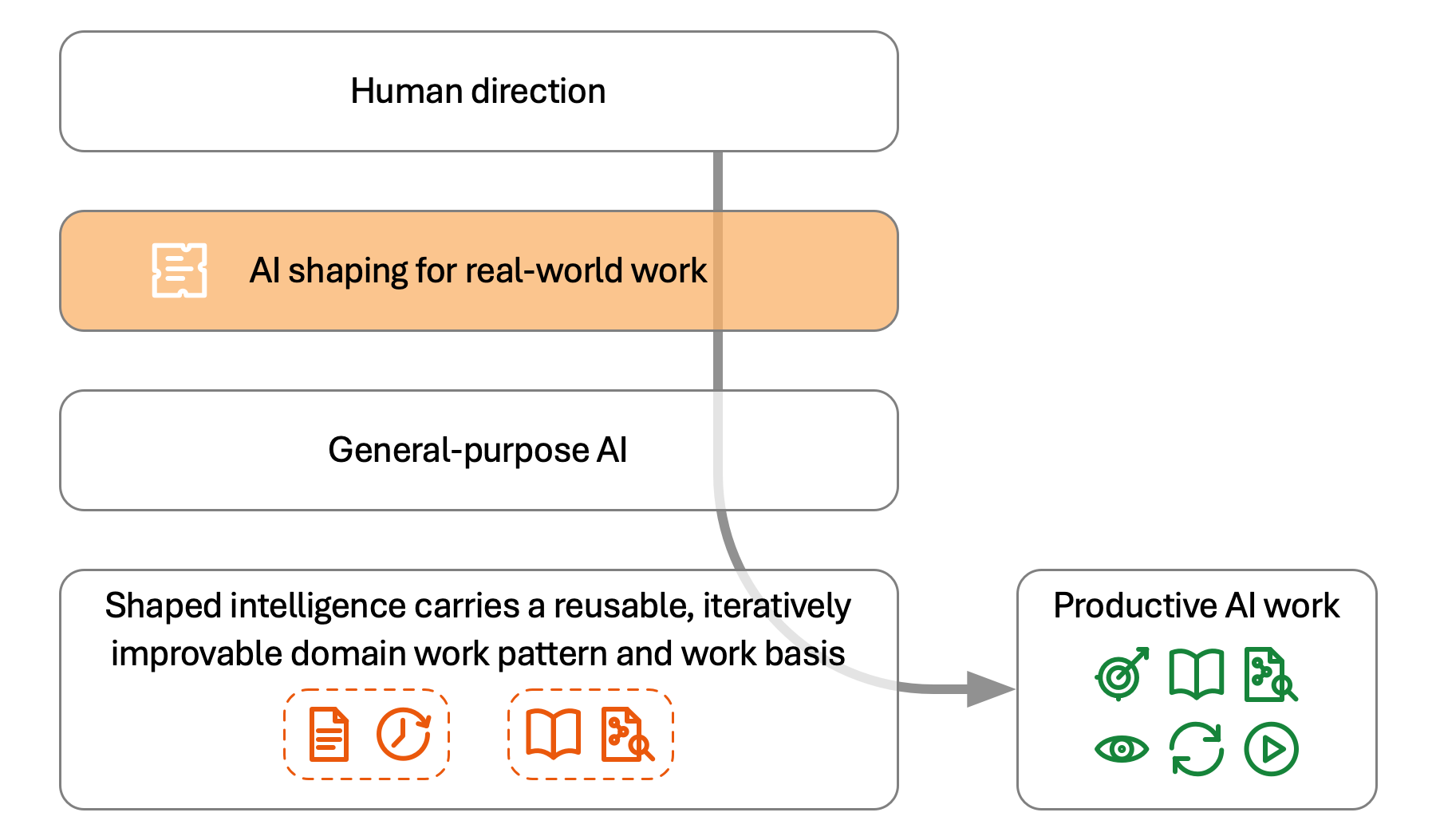
Imagine a real work bundle: ticket notes, emails, screenshots, vendor replies, stakeholder questions and a half-finished status update. Ordinary AI can summarise parts of it, but the person still has to rebuild the work basis before the output can be trusted or continued.
AI shaping establishes a reusable and iteratively improvable domain work pattern and reusable work basis so shaped intelligence can carry more domain-practice and subject-context burden, and more work-state and resumption burden, into recurring work. Long or extended work often makes the reconstruction burden easier to see, but it is not the category definition; source basis is carried forward while judgement, approval and real-world action remain human-owned.
The practical shift: I direct, review and decide. Shaped intelligence carries more of the recurring work.
Use one of the three primary paths first. The complete route set remains available below for comparison, practice, reference and protected-stage questions.
More public routes
A plain-language bridge from the value proposition to the core terms.
Category readerUnderstand the operating-model discipline and adjacent-category boundaries.
Practice readerSee how the three practitioner layers relate without transferring the protected method.
Comparison readerChoose the comparison question that matches construct type, work pattern, tools or adjacent frameworks.
Operational effectSee what changes compared with ordinary AI use.
Evidence readerStart with a bounded, readily inspectable website evidence instance established through the direct-shaping approach, then the four-capability publication-product architecture and the separate mediated capability-evidence route.
Product-management evidenceReview bounded operational establishment supported across repeated accepted cycles; the three-cycle maturity gate remains satisfied through governed automation and publication co-evolution.
Human authoritySee how I retained product direction, priorities, architecture, acceptance and release authority while governed AI capabilities carried recurring delivery work.
Evaluation readerUnderstand what public pages and papers can show, and where public evaluation stops.
Formal readerUse the DOI-backed category and capability-evidence papers for formal review or citation.
Implementation readerUnderstand the conditions for any implementation-level review.
Start with the lightest page that answers the question. Use the plain pages for orientation, the evidence pages for public-stage evaluation, and the DOI-backed papers or protected-stage route only when formal review is needed.
Defines AI shaping as the operating-model discipline for turning broad general-purpose AI capability into productive AI work through two-sided work-burden shift under human direction.
Evaluates the distinct mediated-shaping project-work instance in project and business-as-usual (BAU) IT support contexts.
Evaluates the distinct bounded direct-shaping product instance through selected first-party evidence of recurring coordination burden under human authority.
The homepage gives the value path. The AI shaping concept page gives the fuller website explanation and concept stack; the DOI-backed category definition paper remains the formal public category source.
The public site supports category understanding, bounded evidence review and reader routing; it does not provide implementation guidance or method transfer. For implementation-level review, use the protected-stage discussion pathway.
Page 1 of 31