Use this paper when
- You need the definition of AI shaping.
- You need the concept stack and adjacent-category boundaries.
- You need to understand what the public category definition paper does and does not claim.
A category definition paper on reusable and iteratively improvable work patterns, two-sided work-burden shift, shaping approaches and human-directed productive AI work.
Formal public category-definition paper · Concept DOI · Category definition, not capability evidence.
This page is the website summary of the DOI-backed paper; the paper itself remains the formal public category source. Website explanations may sharpen supported formulations, but this landing page does not attribute later website wording to the paper unless the paper itself carries it.
The landing page summarises and routes. The Concept DOI identifies the evolving paper, resolves to its latest public version and remains the public route for formal wording, version access and citation.
Recurring AI-enabled work can produce useful outputs while leaving people to reconstruct source basis, domain fit, work state and resumption logic. AI shaping is the operating-model discipline that establishes shaped intelligence to carry a reusable and iteratively improvable domain work pattern and reusable work basis under human direction.
Shaped intelligence carries more of the two-sided burden — domain-practice and subject-context, and work-state and resumption — so useful output can become grounded, reviewable, repeatable and resumable productive AI work. The direct-shaping approach establishes bounded shaped intelligence without first materialising separate AI-shaping intelligence; the mediated-shaping approach uses separately reusable AI-shaping intelligence to carry the shaping pattern.
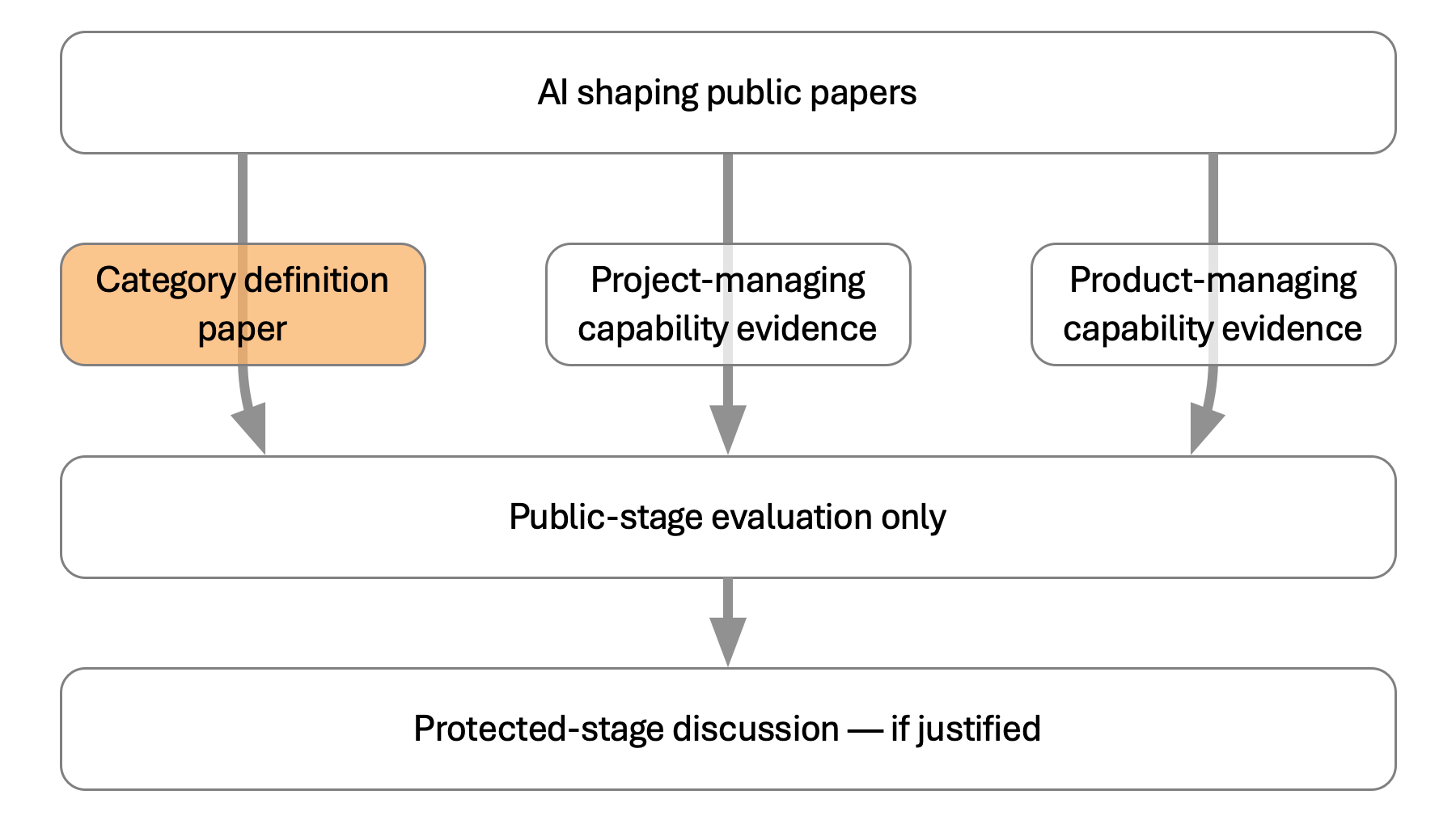
This paper defines the category, supports category-fit decisions and routes readers to separate Project-managing and Product-managing evidence papers. It does not establish capability performance, measured improvement or implementation-transfer authority.
The paper supports category understanding and evaluation routing only; it does not establish capability evidence, measured performance or implementation-transfer authority. Use the Project-managing evidence paper or Product-managing evidence paper when the relevant evidence object warrants review. Implementation-level review belongs in Protected-stage discussion.
Kwok, Kurni. (2026). AI Shaping: Turning General-Purpose AI into Productive AI Work. Zenodo. https://doi.org/10.5281/zenodo.20830022.
AI-Shaping Intelligence in Practice: Evidence from Project-Managing Shaped Intelligence
Evaluates the distinct mediated-shaping project-work instance.
Product-Managing Shaped Intelligence: Evidence from a Bounded Knowledge and Publication Product
Evaluates the distinct direct-shaping bounded-product instance.
The Category Definition paper owns the shared category and concept architecture. The Project-managing paper evaluates the distinct mediated project-work instance. The Product-managing paper evaluates bounded operational maturity, observable but unquantified coordination value and direct-approach contribution within one bounded product.
Page 24 of 31