Use this page when the question is where AI shaping sits beside governance, AI management systems, enterprise adoption, workflow redesign and productivity-evidence language. For prompts, retrieval, copilots, agents and automation, use the separate tools and execution-forms comparison.
In brief: governance frameworks focus on risk, accountability and trustworthy use. AI management systems establish organisation-wide requirements for governing and continually improving AI-related policies and processes. Enterprise-adoption research focuses on workflow redesign and organisational uptake. Productivity studies test whether AI improves measured task outcomes. AI shaping sits beside those categories as the operating-model discipline centred on shifting more two-sided recurring work burden to shaped intelligence while source basis and the human-authority boundary remain explicit.
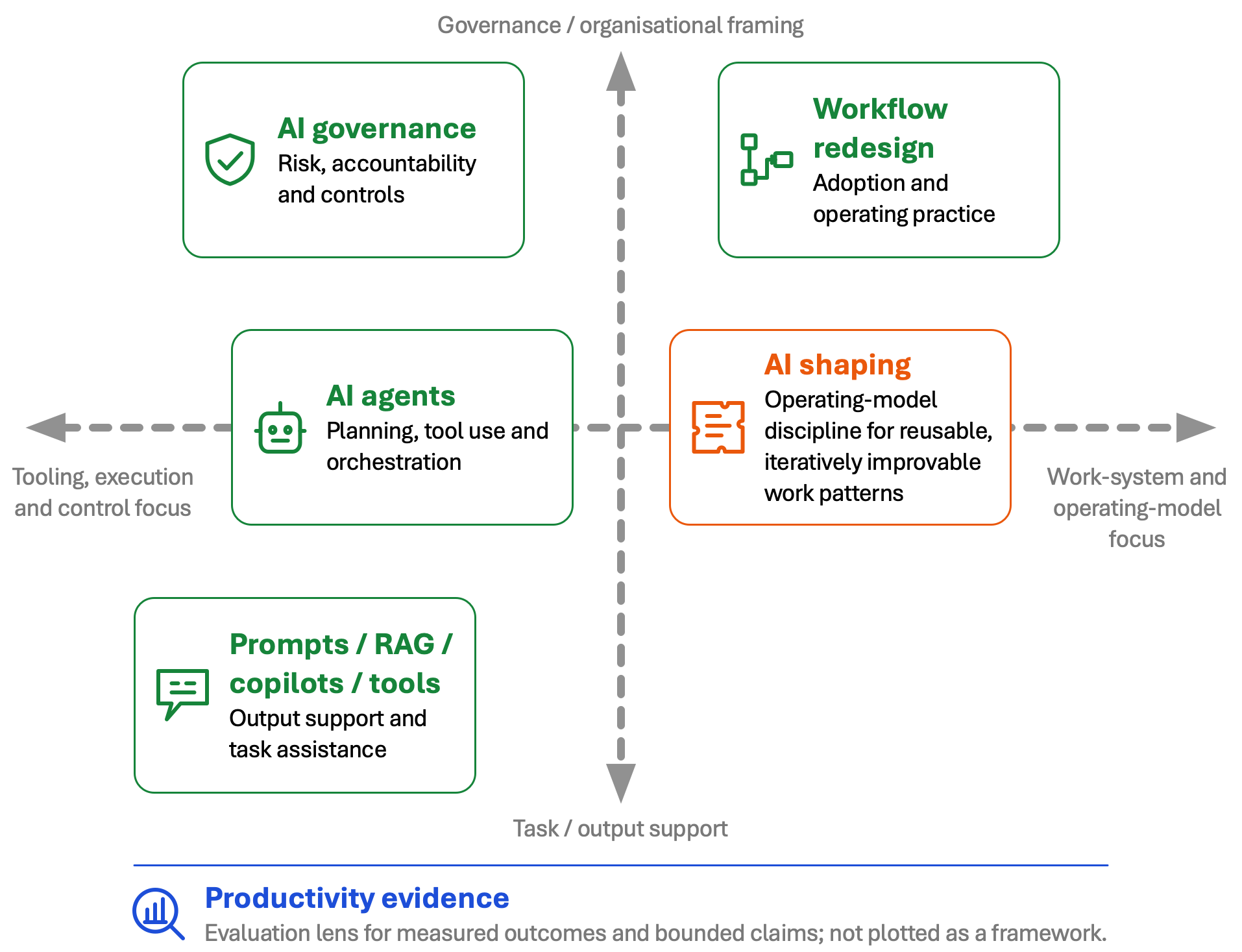
The positioning diagram locates AI shaping beside related organisational, evaluative and execution-form categories without ranking them or treating them as one taxonomy. This page focuses on governance, management systems, workflow redesign, adoption and productivity evaluation; the separate tools comparison covers prompts, retrieval, copilots, agents and automation.
Use this page whenThe question concerns governance, AI management systems, enterprise adoption, workflow redesign or productivity evaluation.
Choose another route whenThe question concerns prompts, agents and automation, or whether the public evidence supports a capability claim.
Context and positioning
Context page, not a new formal source
This page gives a public reader map across adjacent AI source families. It does not replace the category definition paper, the capability evidence paper or the public evaluation map. It also does not make AI shaping a substitute for governance, an AI management system, workflow redesign, adoption work or empirical productivity evaluation.
Adjacent source families and the AI shaping position
Read this as a positioning diagram. Each adjacent source family answers a valid question. AI shaping asks a narrower operating-model question: can more domain-practice and subject-context burden, and more work-state and resumption burden, shift from the responsible person to shaped intelligence while source basis and the human-authority boundary remain explicit?
Adjacent source families and the AI shaping position
Risk management, trustworthy AI, accountability, monitoring and organisational controls.
AI shaping does not replace governance. It helps make the work itself more reviewable, resumable and human-directed so governance and approval boundaries can remain explicit.
Organisation-wide requirements for establishing, implementing, maintaining and continually improving an AI management system.
AI shaping is narrower: it concerns how recurring domain work is arranged so shaped intelligence carries more burden under explicit source and human-authority controls. It can operate within an AI management system; it does not replace one.
Measured task outcomes, productivity effects, perception gaps and setting-specific evidence.
AI shaping should not be read as a generic productivity-uplift claim. The public claim is narrower: visible work-burden shift under human authority, with evidence assessed in context.
Reader test
When this context matters
The organisation already has governance, management-system or adoption structures, but people still carry both recurring burden sides inside the work.
The governance problem is partly a work-design problem: reviewers cannot see source basis, unresolved matters, review state or human-owned next action clearly enough.
The adoption problem is not tool access alone; it is whether the work pattern and reusable work basis let shaped intelligence carry more of the recurring burden.
The productivity question needs to avoid generic AI-uplift claims and instead test a bounded burden-shift signal in a defined work setting.
Boundary
What this context page is not
This context page is not a full literature review, an implementation guide or a claim that AI shaping is superior to adjacent frameworks. Its job is to show where AI shaping fits and then route formal readers to the papers.
How should AI risk, approval and accountability be controlled?
Governance and risk frameworks.
Keep source basis, work state, unresolved matters and the human-authority boundary explicit inside the work pattern.
How should an organisation establish and continually improve its AI policies, processes, roles and controls?
AI management systems.
Provide a bounded operating-model treatment for recurring domain work within the broader management-system context.
Why do AI pilots fail to become operational value?
Workflow-redesign and adoption research.
Identify whether both burden sides are still sitting with people.
Did AI improve measured outcomes in this setting?
Empirical productivity evaluation.
Keep the claim bounded to visible work-burden shift unless stronger evidence supports a broader productivity claim.
Public-stage limit
This page is public-stage positioning material only. It supports category comparison and context; it does not evaluate implementation performance or claim that AI shaping supersedes adjacent frameworks.