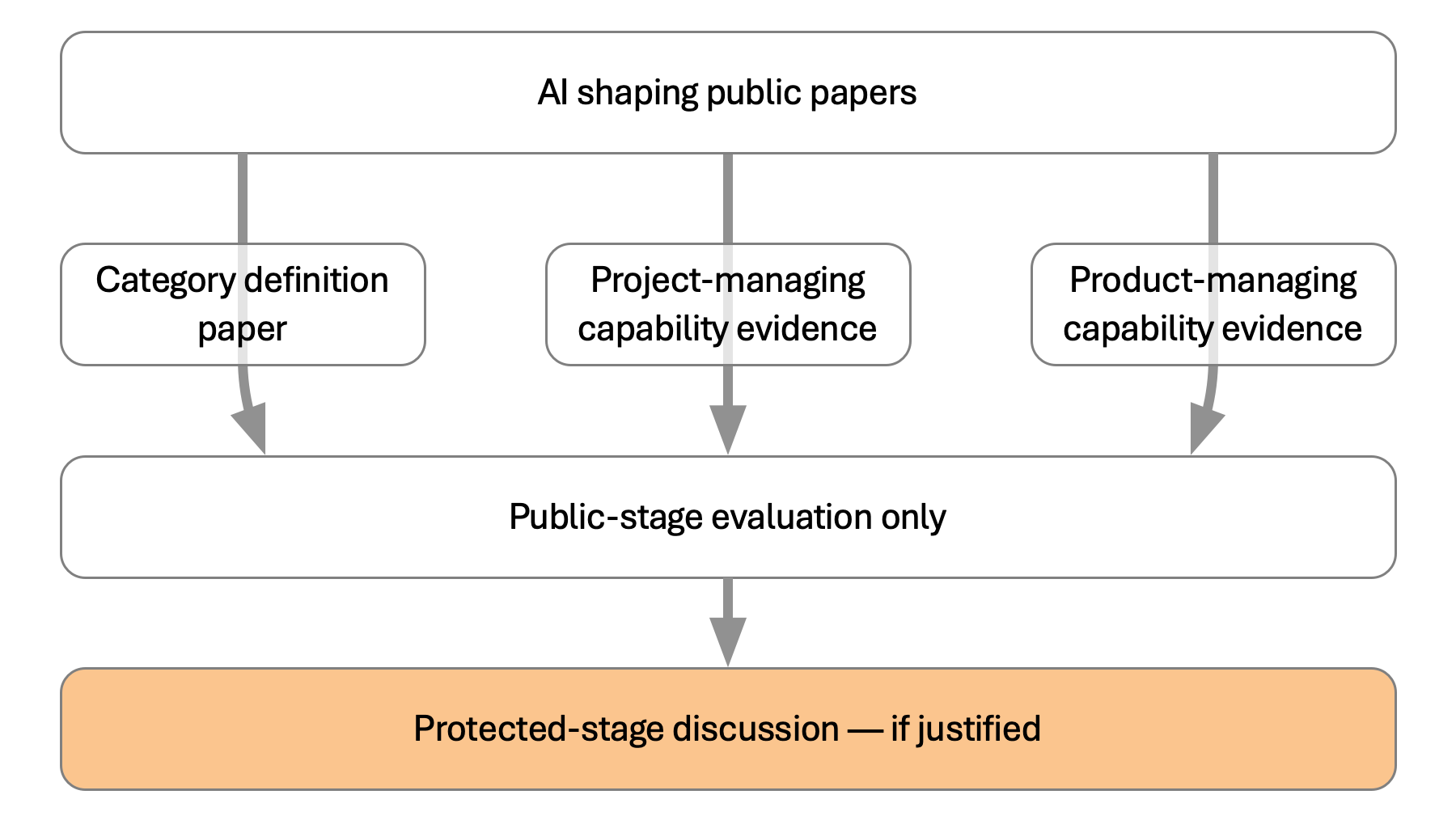
Protected-stage discussion for scoped AI Shaping review
Use this route when a defined evaluation, collaboration, practice, capability, evidence or implementation question cannot be assessed adequately from the public website and papers alone.
Protected-stage discussion is conditional: a relevant work problem, sufficient public evidence and a defined purpose may justify considering a minimum scoped review.
This is the canonical boundary source for deciding whether a question should remain public or move into minimum necessary protected review. Private codification does not itself warrant access or discussion.
A relevant work problem, sufficient public evidence and a defined purpose may justify considering a scoped protected-stage discussion.
Questions that may justify consideration
Whether selected AI Shaping principles or techniques are relevant to a defined work problem.
Whether a proposed capability fits the work object, recurring burden and human-authority boundary.
What practitioner guidance, architecture pattern or evaluation criterion is needed for a scoped decision.
How evidence limitations, rematerialisation or transfer-readiness should be assessed.
Whether an advisory, collaboration, capability-development or implementation-review scope is appropriate.
Whether Product-managing shaped-intelligence evidence is sufficient for a defined product-governance, evaluation or collaboration question.
How recurring product-management burden could be measured without exposing protected controls or overstating transferability.
Whether a different product domain justifies a scoped transfer evaluation after the current maturity and evidence gates are addressed.
Private material that may be relevant
Complete AI Shaping principle specifications, examples and anti-patterns.
Testable expectations and evaluation checks.
Selected shaping techniques, practices or architecture patterns.
Bootstrap, renewal, review or capability-readiness material.
Selected implementation correspondence needed for the defined question.
Only the minimum relevant material should be considered, and only after the protective conditions are agreed.
Safe public explanation
The public site and papers explain the category, core mechanism, evidence roles, current public instances, principles at a compact level and the public evaluation boundary. Use those sources first wherever they can answer the question.
What protected discussion does not promise
The complete private Knowledge practitioner-doctrine surface or terminal retired Practitioner Guide where historical/rollback review is specifically material.
Shaped-control files, prompts, schemas or route controls.
Unrestricted method transfer or deployment assurance.
Commercial-use rights, licensing or a standard protected package.
Access merely because private principles or techniques exist.
Before protected material is reviewed
The public-stage boundary remains in place until the recipient, purpose, confidentiality, ownership, scope and permitted use are agreed.
Conditions before protected material is reviewed
Condition
Purpose
Recipient
Who will receive or participate in the protected review.
Purpose
Why protected review is needed and what defined decision or question it supports.
Confidentiality
How non-public material, context and discussion content will be protected.
Ownership
Who owns existing material, protected method content and any discussion outputs.
Scope
Which role, work problem, capability, evidence or implementation question is included.
Permitted use
What the recipient may and may not do with protected material or discussion outputs.
What to include when emailing
The public page or paper already reviewed.
The defined work problem, evaluation question or decision.
Why public material is insufficient for that specific question.
The proposed recipient, purpose and minimum requested scope.
Any confidentiality, ownership or permitted-use constraints.
After checking the relevant public material, email with the reviewed source, defined work or evaluation question, purpose, recipient and minimum requested scope. The enquiry begins consideration only; it does not authorise disclosure or use.