How recurring work is organised
Shaped intelligence carries the organising structure for recurring work: the role, source relationship, domain-practice expectations, subject-context reasoning, review boundaries and output pattern.
Shaped intelligence is the reusable domain-facing capability that carries a reusable and iteratively improvable domain work pattern and reusable work basis into recurring work. Two-sided work-burden shift is the operational effect while source basis and human authority remain explicit.
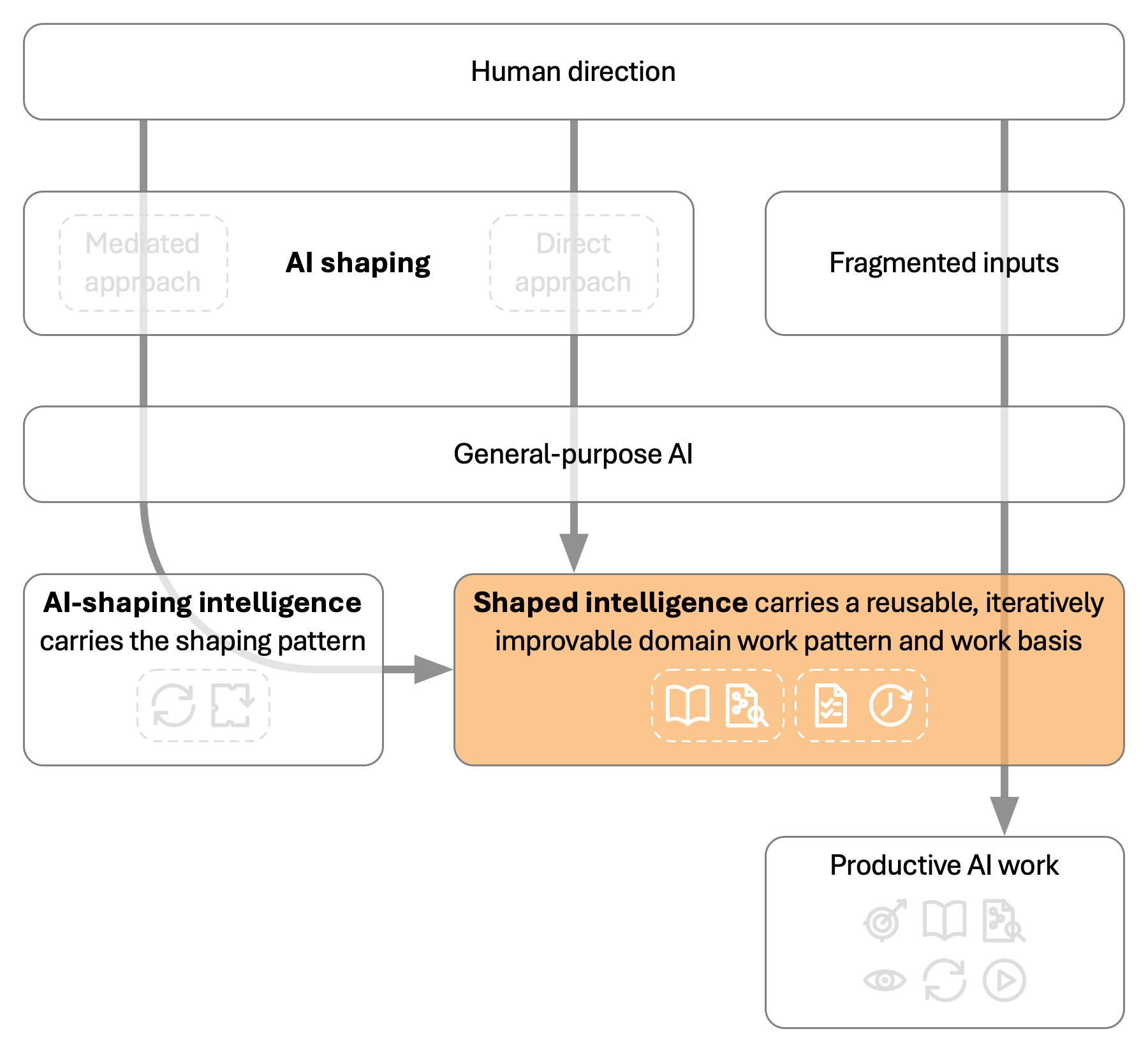
Shaped intelligence is the reusable domain-facing capability. In plain terms, it means the AI contribution starts from a prepared work pattern and preserved work state rather than a fresh generic request.
This makes the page easier to read if you keep one question in mind: what burden no longer has to be rebuilt by the person each time the work resumes?
These four component terms sit within the two formal burden sides. Source basis is carried forward separately, and human authority remains explicit.
Shaped intelligence carries the organising structure for recurring work: the role, source relationship, domain-practice expectations, subject-context reasoning, review boundaries and output pattern.
It carries source basis, relevant practice standards, matter-specific context, current work state and resumption logic so the work can continue rather than restart.
Shaped intelligence is the reusable domain-facing capability established through AI shaping that carries a shaped work pattern and reusable work basis into recurring work, so more two-sided work burden can shift from the responsible person.
In plain English: it is broad AI capability shaped for recurring work in a domain, carrying more of the work pattern and reusable work basis rather than starting from a fresh one-off prompt.
The value is practice context with work-state preservation and work-resumption logic. A person should not need to rebuild the whole AI work basis every time the work resumes, changes hands or receives new information.
The practical difference from ordinary prompting is that the work basis continues, instead of being rebuilt whenever the work changes, pauses or changes hands.
| Adjacent idea | Distinction |
|---|---|
| Raw model capability | Raw capability can answer broadly. Shaped intelligence is fitted to a domain pattern, source basis, review route, domain-practice guidance, subject-specific context, preserved work state and resumption logic. |
| A generated artefact | A generated artefact is an output. Shaped intelligence is the reusable capability that helps carry recurring work burden across outputs. |
| Human replacement | Shaped intelligence carries burden, not responsibility. Human direction, judgement, approval, escalation and real-world action remain with the person. |
A domain-facing support capability that carries recurring reconstruction, sequencing, tracking, risk framing, resumption and communication-preparation work into review-ready form.
The AI Shaping knowledge and publication product now uses four bounded shaped capabilities: Product-managing shaped intelligence at product level, plus Private knowledge-publishing, Published paper-authoring and Public web-developing shaped intelligence as three current publication capabilities. Retired Private paper-authoring remains historical/rollback evidence rather than a current capability. Their distinct work objects and controlled relationship are explained on Product-managing shaped intelligence. Product-managing shaped intelligence is operationally established only within this bounded product rather than as generic capability evidence.
A polished answer that does not remember the work state, unresolved decisions, review basis or next-action logic.
The test is whether repeated work becomes easier to resume, review and continue because shaped intelligence carries both the domain-practice and subject-context burden, and the work-state and resumption burden, while preserving human accountability.
The formally published mediated-shaping capability-evidence instance in project and business-as-usual (BAU) IT support contexts. It makes the domain-practice and subject-context burden explicit before routing to its Capability Evidence paper.
Project-managing evidence paper · Concept DOI: 10.5281/zenodo.20830131
Public concept page only: this page explains the domain-facing capability; it is not a product specification or implementation guide. For the full stop rule, use Protected-stage discussion.
Project-managing shaped intelligence and Product-managing shaped intelligence are peer domain-facing shaped-intelligence capability types with different work domains, reuse boundaries, shaping histories and evidence maturity. Project-managing and Product-managing now have separate formally published Capability Evidence papers. Project-managing evaluates the mediated project-work instance; Product-managing evaluates the bounded direct-shaping product instance through retrospective first-party evidence. Their different evidence objects do not make either capability categorically higher or interchangeable.
Page 8 of 31