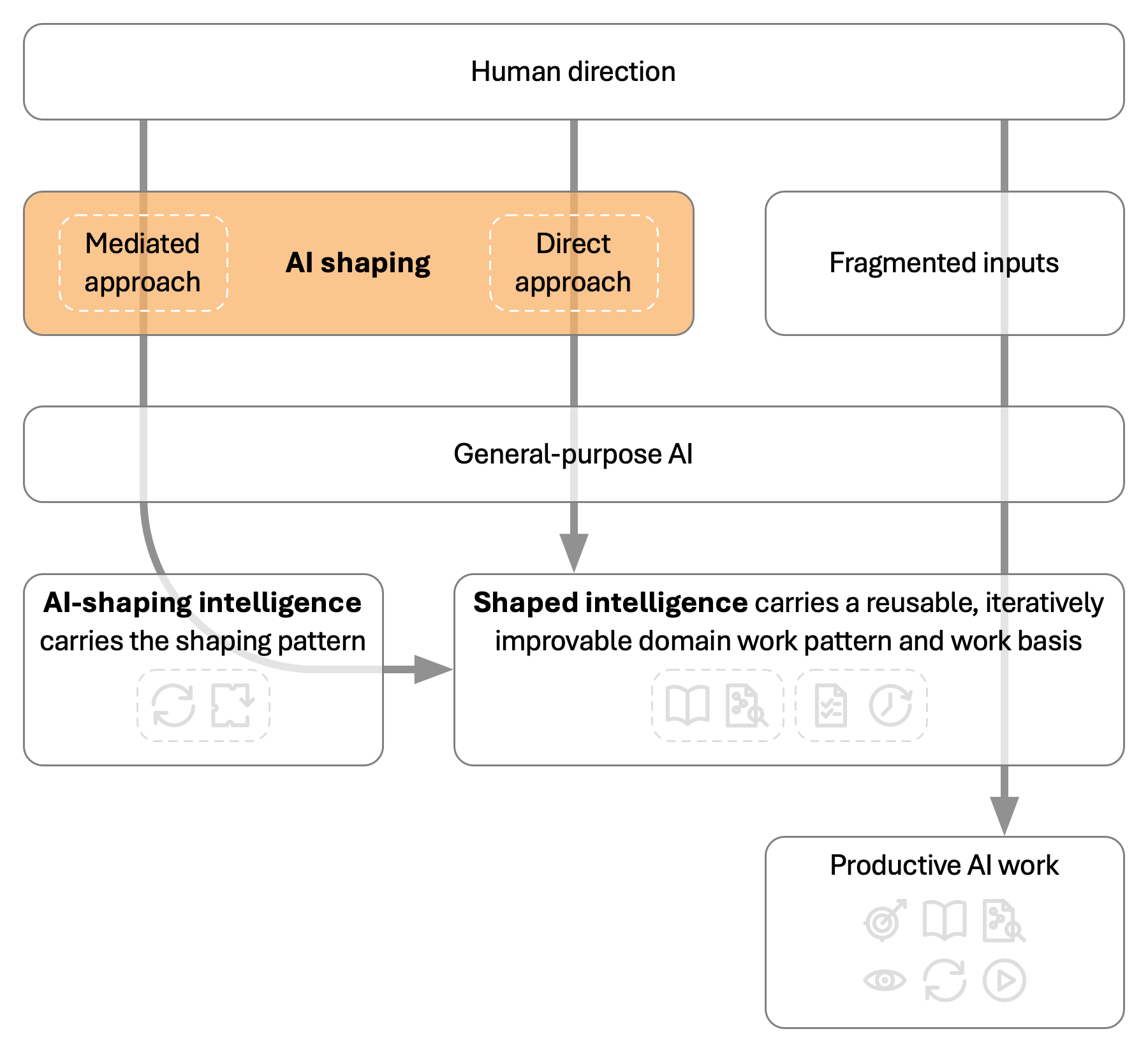
AI shaping turns useful AI output into productive AI work
AI shaping is the operating-model discipline for establishing shaped intelligence that carries a reusable and iteratively improvable domain work pattern and reusable work basis. Two-sided work-burden shift is the operational effect; productive AI work is the outcome; source basis and the human-authority boundary remain explicit.
AI shaping establishes shaped intelligence through either the direct-shaping approach or the mediated-shaping approach. Shaped intelligence carries a reusable and iteratively improvable domain work pattern and reusable work basis, producing two-sided work-burden shift and productive AI work under human direction.
Category concept
Start with the category itself
This is the canonical website concept page. For the lighter entry, start with AI shaping in 5 minutes; the DOI-backed category definition paper remains the formal public category source.
Read this page when you want the category definition, adjacent-category boundaries and the basic mechanism behind work that can continue, be reviewed and be reused.
AI shaping establishes a reusable and iteratively improvable domain work pattern: the role, source relationship, domain-practice expectations, subject-context reasoning, review boundaries and output expectations for a recurring kind of work.
Reusable work basis
Carry the work forward
Shaped intelligence carries the reusable work basis into recurring work: source basis, relevant domain-practice standards, matter-specific context, current work state and resumption logic. Work can continue rather than restart.
The whole architecture in one view
Read the architecture as five connected views. The specialist pages explain each view in more depth; this section keeps the full relationship visible in one place.
AI shaping is an operating-model discipline centred on two-sided work-burden shift. It aims to move more recurring burden to shaped intelligence while preserving source basis and the human-authority boundary; the formal definition appears below.
Shaping approaches
Direct-shaping approach and mediated-shaping approach
Direct-shaping approach: under human direction, the AI-shaping discipline is applied directly to establish a bounded shaped capability without first materialising separately reusable AI-shaping intelligence. It may still support sophisticated or long-running work. Mediated-shaping approach: under human direction, the discipline is applied through AI-shaping intelligence where separately reusable shaping capability, repeated rematerialisation, extension or cross-domain transfer evaluation justifies the added architecture. Use the least elaborate reliable shaping architecture.
Public web-developing shaped intelligence provides a bounded, readily inspectable website-specific instance established through the direct approach and reused across successive revisions of this website. Separately, the published project evidence route shows the mediated-shaping approach through AI-shaping intelligence: vendor-evaluating shaped intelligence extended into broader project-managing shaped intelligence, where visible two-sided work-burden shift in real project and BAU IT support work remains the primary capability-evidence signal.
Product-managing shaped intelligence is operationally established within the bounded AI Shaping knowledge and publication product, supported by strong bounded first-party operational evidence across repeated accepted cycles. The three-cycle maturity gate remains satisfied. It carries recurring product-state, owner-selection, sequencing, reconciliation and resumption burden through governed automation under human acceptance. Publication co-evolution through reciprocal refinement is a principal mechanism across the three current publication capabilities; it is not the umbrella capability or autonomous coordination. The product-ownership page explains the human role without changing the category definition.
Planned capability directions
Three planned directions, not current evidence
Stock-evaluating shaped intelligence, portfolio-managing shaped intelligence and code-developing shaped intelligence share the same public claim status: planning context outside current evidence. Stock evaluation is deliberately bounded to one listed stock and is not portfolio-aware; portfolio management is a possible later superset extension. Use Planned capability directions for the bounded development-and-dependency view.
Public lifecycle
How a shaped capability develops
The public lifecycle is intentionally compressed: Qualify and bound → Establish and accept → Apply and reuse → Evaluate and improve → Adapt, extend, transfer-evaluate or retire. Detailed gates, control files, readiness scoring and recovery mechanics remain outside the public site.
Explore the core concepts
Use the specialist page that matches the concept question. This page remains the canonical category overview and keeps their relationship visible as one architecture.
AI shaping is the operating-model discipline for establishing shaped intelligence that carries a reusable and iteratively improvable domain work pattern and reusable work basis. Its operational effect is two-sided work-burden shift: more domain-practice and subject-context burden, and more work-state and resumption burden, move from the responsible person to shaped intelligence while source basis and the human-authority boundary remain explicit.
In plain English: AI shaping turns the underlying structure of recurring work into a reusable and improvable pattern that shaped intelligence can carry. More of the repeated burden can then shift away from prompt rebuilding while judgement, approval and real-world action remain human-owned. It does not alter the model’s trained weights.
Why this term is needed
Useful AI output can still leave the person carrying the real burden of work: rebuilding context, checking assumptions, sequencing next steps, preserving state and turning output into something safe to use.
In complex or extended work, this often means rebuilding a long or complex prompt with sources, prior decisions, constraints, risks, review status and next action before the AI can help again. The repeated work is not only rebuilding context; it includes applying domain-practice expectations and subject-context reasoning before the output can be reviewed or used. AI shaping addresses that gap by designing the operating pattern around the AI contribution. The simple mechanism is that the long prompt stops being treated as a one-off instruction and becomes part of a reusable, reviewable and improvable work pattern.
How it differs from adjacent ideas
How it differs from adjacent ideas
Adjacent idea
Distinction
Prompt engineering
Prompt engineering may improve an individual request. AI shaping is broader: it concerns the recurring operating pattern, source basis, review route, resumability and human authority around the work.
AI automation
Automation can execute a predefined flow. AI shaping is concerned with whether shaped capability can carry recurring work burden while humans retain judgement, approval and action.
AI governance
Governance sets rules and controls. AI shaping focuses on the operating-model discipline that makes productive AI work practice-guided, subject-aware, repeatable, reviewable and resumable within those controls.
For a fuller comparison across prompt engineering, agents, workflow automation, governance, RAG, copilots, project tools, model fine-tuning and generic AI productivity, use the one-page comparison.
For the public practice architecture, read AI Shaping principles, lifecycle and operational patterns. The principles govern the lifecycle and the mixed operational-pattern layer; the page remains a bounded public view rather than implementation transfer or a replacement for the formal category and evidence sources.
Example
A project support pattern that preserves issue history, unresolved decisions, next actions, stakeholder-ready drafting and review boundaries across repeated work cycles.
Non-example
A one-off AI answer that looks helpful but requires the person to rebuild the whole context, source basis, review status and responsibility route every time.
Assessment signal
The practical signal is whether more of both burden sides move into shaped intelligence while source basis is carried forward and the human-authority boundary remains intact. Work burden shifts; accountability does not.
Public concept page only: this page explains and routes the category; it does not provide implementation guidance or method transfer. For the full stop rule, use Protected-stage discussion.