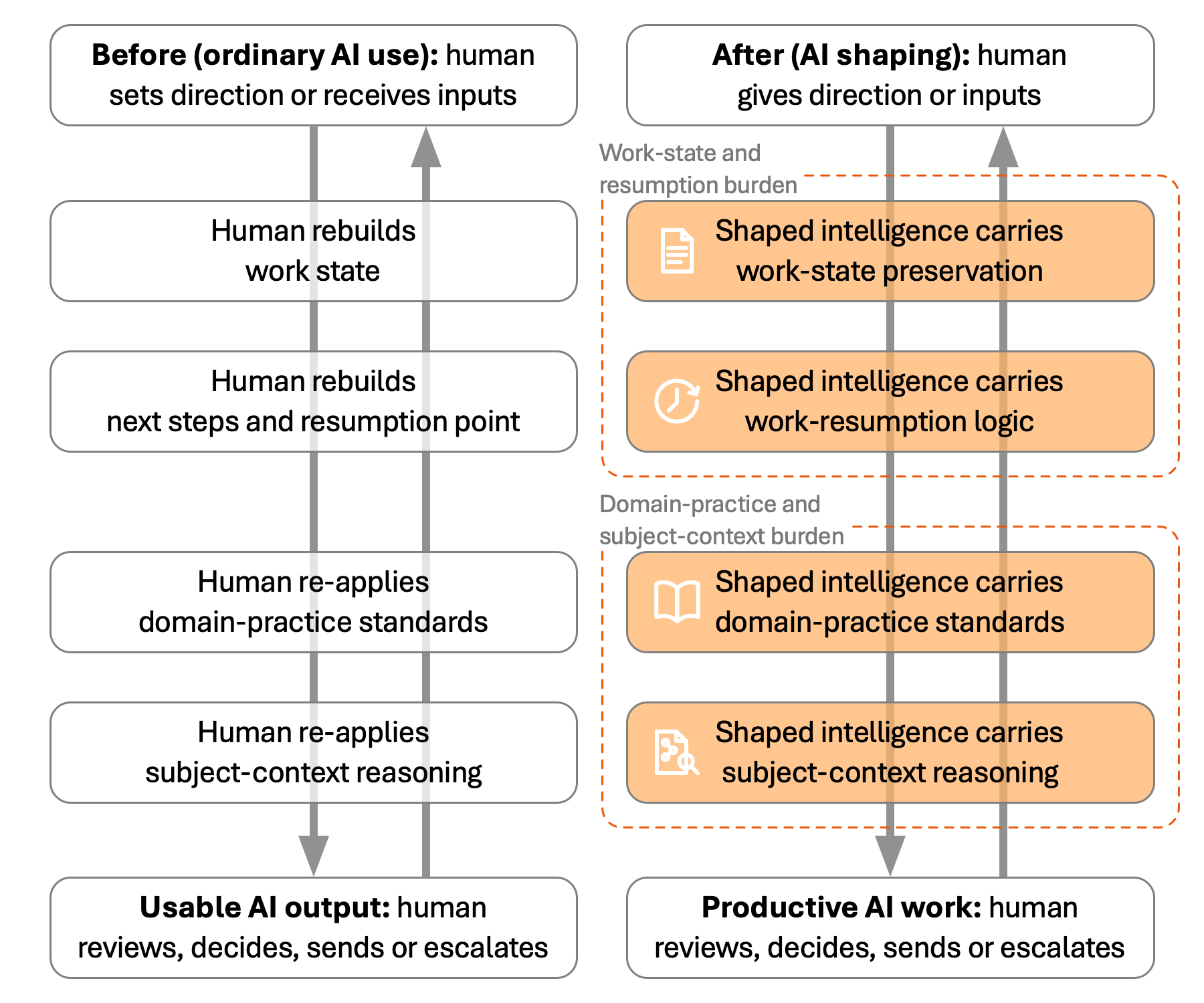
Work-burden shift is the operational effect and primary capability-evidence signal of AI shaping. It shows whether shaped intelligence is carrying more domain-practice and subject-context burden, and more work-state and resumption burden, while source basis and the human-authority boundary remain explicit.
Two-sided work-burden shift is the visible operational effect: the two connected burden sides move from repeated human rebuilding to shaped intelligence. Source basis remains the grounding condition, while judgement, approval and real-world action remain human-owned.
Operational effect
The friction is the work before the AI output can be used
Work-burden shift is easiest to see when the person is not merely asking AI for a better answer, but repeatedly rebuilding two kinds of conditions: the domain-practice and subject-context side of the work, and the work-state and resumption side that preserves state and keeps work resumable.
Do you restate the background and source basis every time?
Do you re-apply domain-practice standards before AI can help?
Do you re-explain subject-specific context and reasoning?
Do you recreate unresolved matters, review status and next action?
Do you rebuild the resumption point after every pause?
Before and after, compact
Before, the person keeps rebuilding domain fit, subject context, work state and the resumption point for the AI. After, shaped intelligence carries more of both recurring burden sides through a shaped work pattern and reusable work basis, so the person directs, reviews and decides instead of starting again.
Definition
Work-burden shift is the visible before/after change where more recurring work burden moves from the responsible person to shaped intelligence while judgement, approval and real-world action remain human-owned.
The shift has two formal burden sides. The component terms used on this site are domain-practice standards, subject-context reasoning, work-state preservation and work-resumption logic.
In plain English: the test is whether the person has less recurring work to rebuild, carry, apply and restart.
AI shaping shapes the work pattern and arranges the reusable work basis; shaped intelligence carries more of the recurring burden while the person still owns the decisions.
Why this term is needed
The relevant question is not whether an AI output is impressive. It is whether the operating pattern changes how much of both burden sides the person must keep carrying before AI output can become usable work.
Relevant practice expectations, subject-specific context and interpretation fitted to the work.
Work-state and resumption burden
Work-state preservationWork-resumption logic
Current state, unresolved matters, review status, next action and the logic needed to resume without rebuilding the work basis.
Conditions around the shift: source basis is carried forward so the work can remain grounded; the human-authority boundary is preserved so purpose, supplied context, judgement, review, approval, disclosure, escalation, communication, decisions and real-world action remain human-owned. Neither condition is a third burden side.
How it differs from adjacent ideas
How it differs from adjacent ideas
Adjacent idea
Distinction
Responsibility shift
Work-burden shift is not responsibility shift. Judgement, approval and real-world action remain human-owned.
Productivity claim
A productivity claim may be broad or vague. Work-burden shift asks what burden moved, what remained human-owned and what evidence supports that view.
Reproducibility proof
Public evidence can support initial capability evaluation, but protected-stage review is required before stronger method-transfer claims.
Example
Before, the person repeatedly rebuilds the AI work basis. After, shaped intelligence carries more of the two-sided recurring burden through a shaped work pattern and reusable work basis, while the person still directs, reviews and approves.
Non-example
A faster draft that still requires the person to recreate the work basis, review status and resumption point from scratch.
Assessment signal
The visible burden areas include rebuilding the work basis, sequencing, drafting, tracking, dependency and risk framing, domain-practice and subject-context application, work-state and resumption handling, and communication preparation. Read these as both burden sides, not as four separate burdens.
Project-managing evidence paper
AI-Shaping Intelligence in Practice: Evidence from Project-Managing Shaped Intelligence
Presents the distinct mediated-shaping project-work evidence object in project and BAU IT support contexts.
Public operational-effect page only: this page explains the burden-shift test; it is not measured productivity proof or implementation guidance. For the full stop rule, use Protected-stage discussion.
Within the AI Shaping knowledge and publication product, Product-managing shaped intelligence carries accepted-state reconstruction, source and owner resolution, priority and dependency management, one-active-capability selection, sequencing, reconciliation and resumption into review-ready form.
Repeated accepted cycles support bounded operational establishment and an observable but unquantified reconstruction and routing-burden signal; the three-cycle maturity gate remains satisfied. Human product ownership, stewardship and decision authority remain controlling. Review the bounded capability evidence or see the human product-authority account.