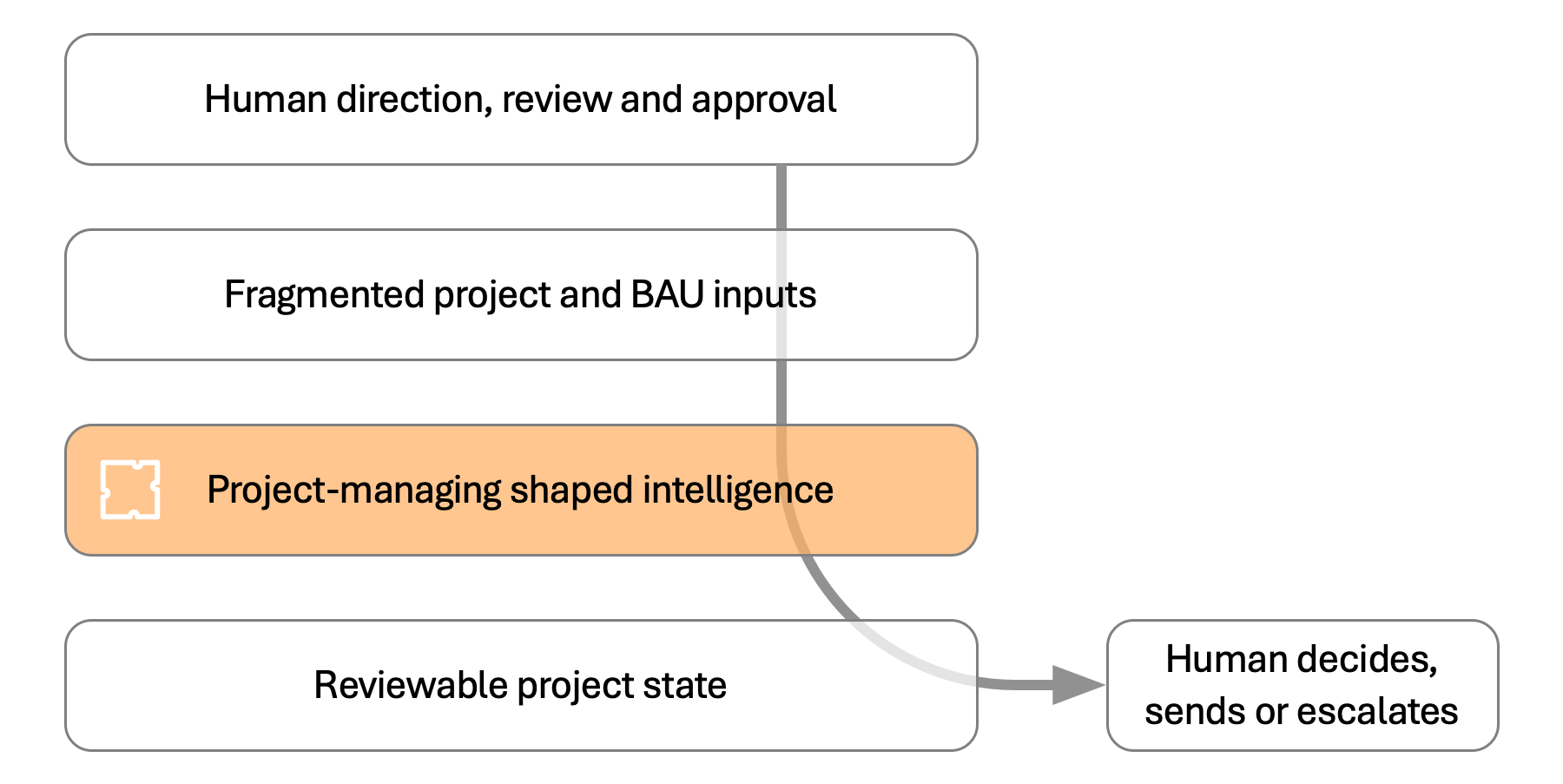
Project-managing shaped intelligence is the formally published mediated-shaping capability-evidence instance developed through the mediated-shaping approach. It carries more recurring project and BAU IT support work burden while source basis and human authority remain explicit.
Fragmented project and BAU inputs include tickets, emails, vendor replies, screenshots and stakeholder questions. Reviewable project state includes open issues, risks, dependencies, next actions and communication drafts, while the human remains responsible for direction, review, approval, decisions, sending and escalation.Concrete entry point
A project-support situation a cold reader can picture
A ticket export shows several unresolved support items. A vendor reply changes one dependency. A stakeholder wants a status snapshot. A human still needs to decide, approve and send, but the repeated burden is turning fragmented inputs into a reviewable project state: what progressed, what remains open, what depends on whom, what risk needs attention and what communication is ready for review.
Project-managing shaped intelligence is the evidence instance used to show that more of that reconstruction, sequencing, risk framing, state preservation and communication-preparation burden can move to shaped intelligence under human authority.
For professional evaluation, the case makes connected project-delivery work visible across source reconstruction, dependency and risk framing, cumulative state, review status and stakeholder communication preparation.
Evidence route position
Place the project-managing case in the mediated evidence route
This page makes the domain-facing project-managing shaped-intelligence instance easier to picture. Use AI-shaping intelligence evidence for the shaping-capability instance, the public evaluation map for the route and the Project-managing evidence paper for the formal evidence test.
Project work pattern and state
How the project-support pattern works
In practical terms, I direct, review and decide while project-managing shaped intelligence carries more of the recurring project-work burden.
The two burden sides shift together. On the domain-practice and subject-context side, shaped intelligence carries more of the project and support practice expectations and matter-specific reasoning. On the work-state and resumption side, it preserves current state, unresolved matters, decisions, review status, pending work and next-action logic.
Source basis remains visible across both sides, and the human-authority boundary remains intact. That makes each new input easier to digest because the project does not have to be reconstructed from scratch before useful AI-supported work can continue.
Definition
Project-managing shaped intelligence is the formally published mediated-shaping capability-evidence instance in project and business-as-usual (BAU) IT support contexts, carrying more domain-practice and subject-context burden, and more work-state and resumption burden, while source basis remains visible and human authority remains explicit.
For cold readers, reconstruction means rebuilding the project work basis in a prompt. Resumption means continuing from a preserved project state instead of starting again.
In plain English: it is not simply an AI that writes project text. It is a shaped capability that helps keep the project work basis organised, resumable and reviewable.
Why this page exists
This page links the general shaped intelligence concept to the public project and BAU IT support evidence instance. The detailed evidence test sits in the capability-evidence paper.
How it differs from project-management tools
How it differs from project-management tools
Project-management tools
Project-managing shaped intelligence
Organise project information, tasks and delivery artefacts.
Carries interpretation, sequencing, dependency/risk framing and unresolved-matter logic.
Track visible project status and workflow movement.
Helps the responsible person continue from preserved project state while authority remains human-owned.
Usually operate as a platform, system of record or workflow surface.
Can work before, around, after or instead of a tool by turning fragmented project material into reviewable project state.
Help people manage visible project artefacts.
Helps the responsible person continue, review and communicate project work from a preserved work basis while judgement, approval and real-world action remain human-owned.
This distinction matters because project work is the evidence environment, not a software-product category. The case demonstrates an operating-model capability across project delivery and BAU IT support: whether recurring work burden visibly shifts to shaped intelligence under human authority, not whether a new project-management platform is being described.
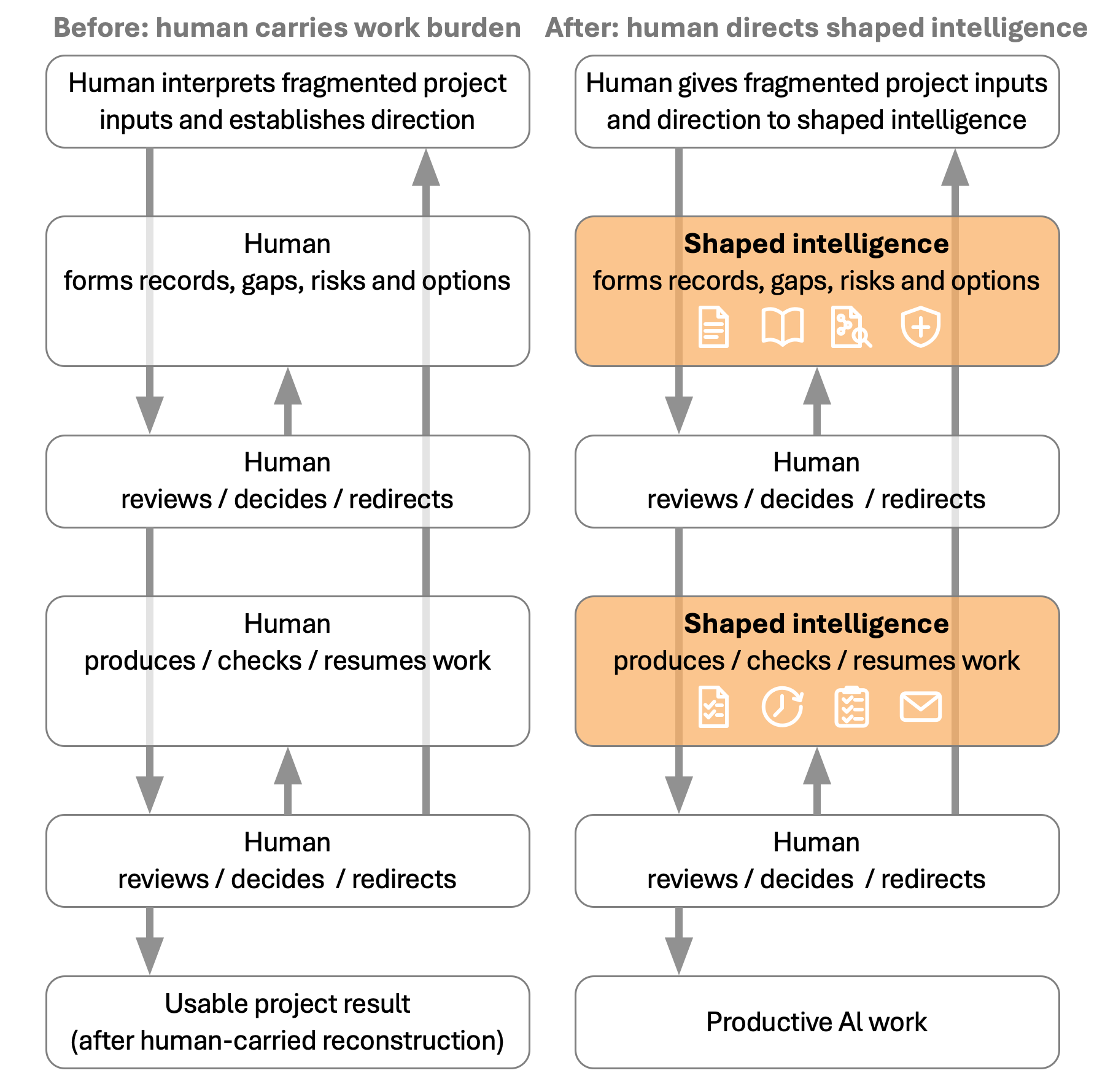
Before/after burden-shift pattern
Before/after burden-shift pattern for project-managing shaped intelligence.
This is the primary public capability-evidence signal: more of both burden sides move to shaped intelligence while source basis remains visible and purpose, supplied context, judgement, review, approval, disclosure, escalation, communication, decisions and real-world action remain human-owned.
What it carries
What it carries
Work component
Plain-English meaning
Source basis
Keeping relevant project and support source material, provenance and supplied context visible as the grounding basis for reviewable work.
Domain-practice standards
Carrying relevant project-management and support-practice standards, methods and review expectations into recurring work.
Subject-context reasoning
Using the subject-specific context of the project, issue, stakeholder position or support environment to frame useful work.
Dependency and risk framing
Surfacing dependencies, blockers, constraints and risk implications for human review.
Work-state preservation
Keeping current project state, unresolved matters, decisions and review status stable enough for work to continue after change or pause.
Work-resumption logic
Preserving the continuation point, pending work and next-action logic so work can resume without rebuilding the project basis from scratch.
Sequencing and tracking
Keeping work steps, dependencies, open items and next actions coherent across pauses and updates.
Communication preparation
Preparing reviewable communication material while the human retains the decision to send, escalate or approve.
Public evidence map
Public evidence map
Evidence focus
What the public reader can check
Boundary
Recurring work burden
The Project-managing Capability Evidence paper tests whether both formal burden sides visibly shift away from the responsible person: domain-practice standards and subject-context reasoning, plus work-state preservation and work-resumption logic. Sequencing, tracking, risk framing and communication preparation are visible project-work expressions of that broader burden shift.
The public test supports initial capability evaluation only.
Human authority
Supplied context, judgement, review, approval, disclosure, escalation, communication, decisions and real-world action remain with the responsible person.
The evidence does not claim autonomous authority or replacement of the responsible person.
Project and BAU IT support context
The evidence instance is framed around recurring project and BAU IT support work burden.
The public material does not transfer the protected shaping method.
Domain extension
Vendor-evaluating shaped intelligence extended into project-managing shaped intelligence because vendor evaluation is a subset of broader project-management work.
This supports bounded domain-extension evidence only; it does not prove domain transfer to unrelated work domains.
Before/after assessment
The relevant question is whether repeated work becomes easier to continue, review and communicate without rebuilding the project context each time, because more of the two-sided project-work burden is carried by shaped intelligence while source basis and human authority remain explicit.
This is not deployment assurance, reproducibility proof or product-performance assurance.
What it does not carry
It does not own judgement.
It does not approve work.
It does not decide escalation.
It does not communicate externally on its own.
It does not take real-world action.
Public boundary
This page supports bounded public-stage capability evaluation only; it does not establish deployment readiness or method transfer. Use Public evaluation map for the evidence route; implementation-level review belongs in Protected-stage discussion.
How it relates to shaped intelligence
Shaped intelligence is the broader domain-facing reusable capability. Project-managing shaped intelligence is the formally published mediated-shaping capability-evidence instance in project and BAU IT support contexts. It also shows domain extension from vendor-evaluating shaped intelligence within the broader project-management work family. For a more readily inspectable website-specific instance of the same burden-shift test, see public web-developing shaped intelligence; the project-managing instance carries materially greater state-preservation and resumption load.
How it relates to work-burden shift
The assessment question is whether more two-sided project-work burden moves to shaped intelligence without forcing the person to rebuild the project context each time. Source basis remains visible and the human-authority boundary remains intact: work burden shifts; accountability does not.
Peer relationship with Product-managing shaped intelligence
Project-managing shaped intelligence and Product-managing shaped intelligence are peer domain-facing capability types with different work domains, reuse boundaries, shaping histories and evidence objects.