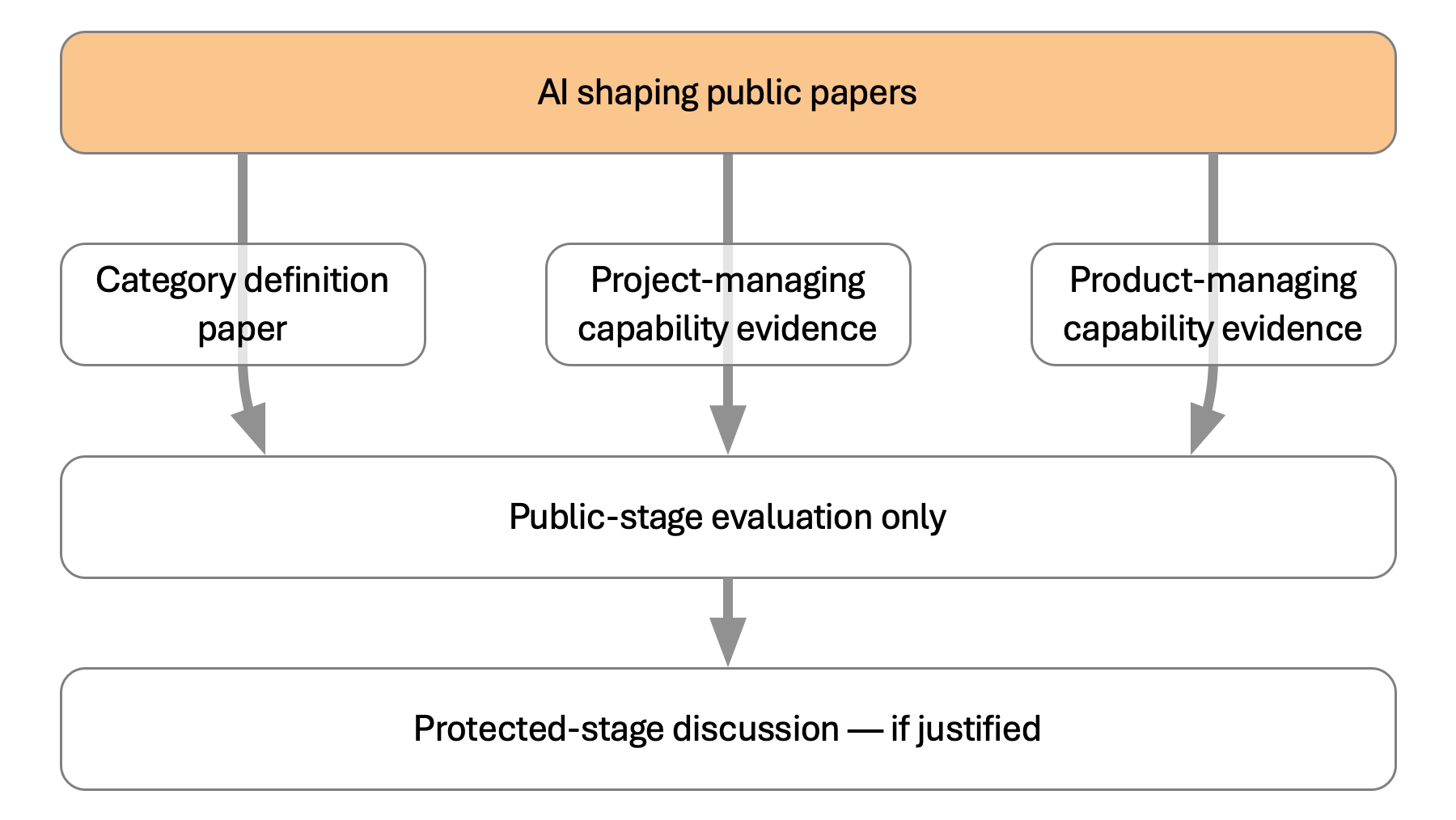
AI shaping papers: category definition and two capability evidence papers
The Category Definition paper owns the shared concept architecture. The Project-managing and Product-managing Capability Evidence papers evaluate distinct shaped-intelligence instances established through the mediated-shaping and direct-shaping approaches.
Formal public v1.94 · Three DOI-backed published papers · Separate evidence objects and limitations.
The three-paper set separates shared category definition from two distinct capability-evidence objects before any protected-stage discussion is considered.Choose a paper
Start with the lightest useful route
Use the Category Definition paper for category fit and concept architecture. Use the Project-managing evidence paper for the mediated project-work instance. Use the Product-managing evidence paper for the direct-shaping bounded-product instance. Each paper remains independently readable and controls a different public question.
Latest version and DOI route
Current published paper set: v1.94 · paper files last updated 30 July 2026, 8:52 pm AEST
All three papers are DOI-backed public papers published on Zenodo. Use the landing pages and DOI records for version access, citation details and the public-use boundary.
The wider product relationship is explained on Product-managing shaped intelligence; publication does not remove the separate evidence objects or expand their permitted conclusions.
Use boundary
The papers support category understanding and bounded public-stage evidence evaluation. They do not provide implementation guidance, deployment assurance, reproducibility proof, measured-improvement proof, method transfer or commercial-use authority.
Evaluates bounded operational maturity, observable but unquantified coordination value and a limited direct-approach contribution argument within the bounded product.
Explains the public-stage and protected-stage boundary.
Category Definition
AI Shaping: Turning General-Purpose AI into Productive AI Work
Defines the shared category and concept architecture, including two-sided work-burden shift, direct and mediated shaping, and the human-authority boundary.
Product-Managing Shaped Intelligence: Evidence from a Bounded Knowledge and Publication Product
Evaluates bounded operational maturity, observable but unquantified Product-coordination value and direct-approach contribution in one bounded product under human authority.
The Category Definition paper owns the shared category and concept architecture. The Project-managing paper evaluates the distinct mediated project-work instance. The Product-managing paper evaluates bounded operational maturity, observable but unquantified Product-coordination value and direct-approach contribution within one bounded product. Publication does not quantify effect, establish sole causation, independent validation, replication, generic transferability, implementation readiness or general direct-shaping superiority.