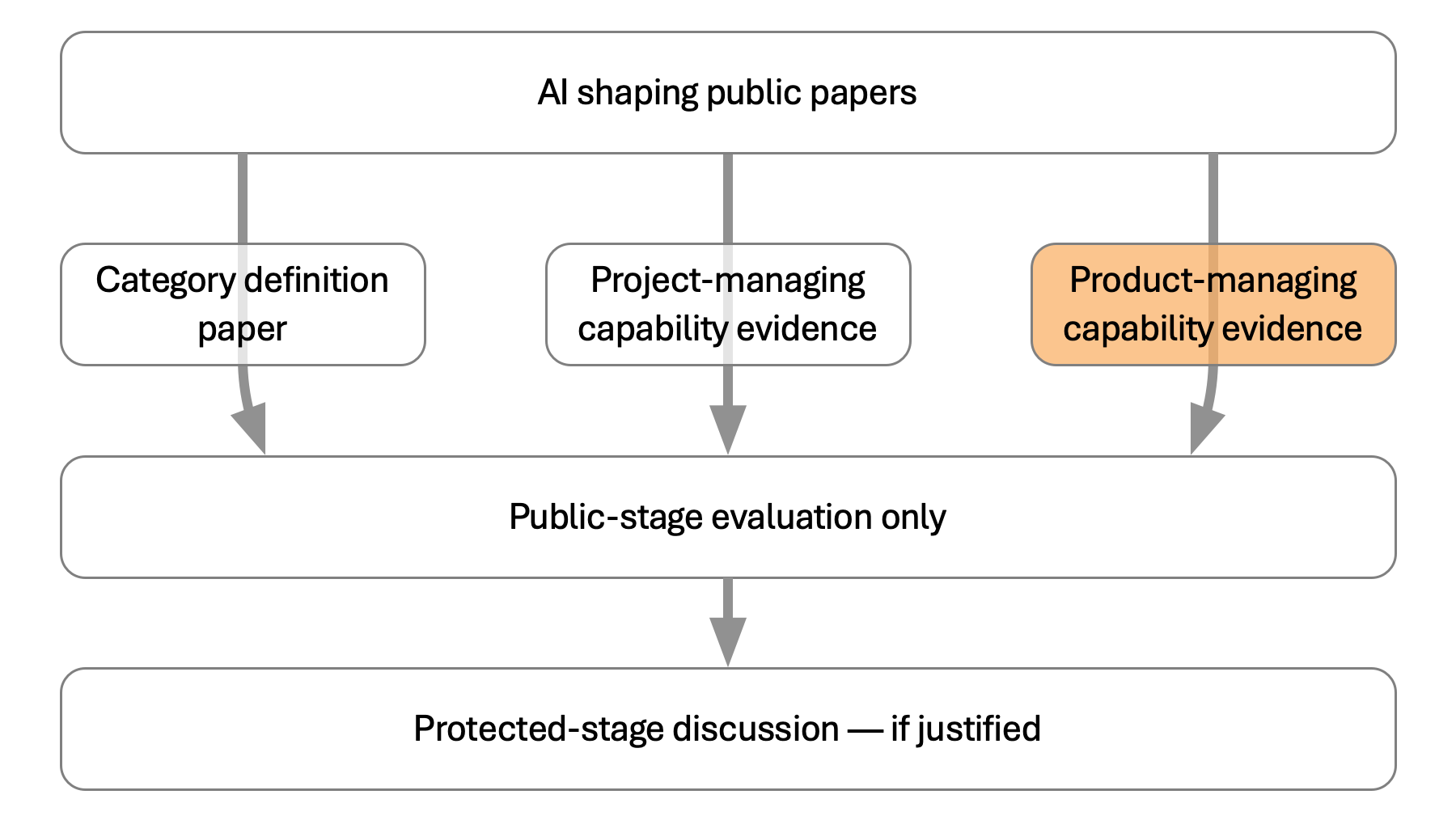
It evaluates one bounded Product-managing shaped-intelligence evidence object and one completed programme instance within that evidence boundary, established through the direct-shaping approach.
It examines recurring product-coordination burden across the AI Shaping knowledge and publication product.
It supports initial bounded evaluation only, not generic Product-management capability, measured improvement or implementation transfer.
The landing page summarises and routes. The DOI record remains the public route for the formal paper, version access and citation.
Paper roleBounded Product-managing operational-maturity, observed-value and direct-approach evidence
Permitted conclusionProduct-managing shaped intelligence is operationally mature within the bounded AI Shaping knowledge and publication product; repeated accepted operation shows observable but unquantified coordination value; and the case contributes first-party evidence that direct shaping can create operational value in this context.
Stop ruleDo not infer quantified effect, sole causation, independent validation, generic transferability, autonomous product management, implementation readiness, deployment assurance or general superiority of the direct-shaping approach.
Use this paper when
You need the bounded Product-managing evidence object.
You need the completed programme instance and the three anchor cases: governed continuation, human correction and deliberate stopping or prevented propagation.
You need the explicit limitations on first-party, retrospective and unquantified evidence.
Creative Commons Attribution-NonCommercial-NoDerivatives 4.0 International (CC BY-NC-ND 4.0)
Evidence test
Public reader should check
Use the paper to check whether the selected record supports initial evaluation of recurring coordination burden shift under human product authority.
Eight purposively selected first-party cases.
Three anchor cases covering continuation, correction and deliberate stopping.
Observable but unquantified burden shift.
Human-owned purpose, judgement, correction, acceptance and consequential action.
Abstract
Product-managing shaped intelligence is evaluated within the bounded AI Shaping knowledge and publication product. Established through the direct-shaping approach, the capability is tested against three separate propositions: bounded operational maturity; observable but unquantified coordination value and work-burden shift; and a limited first-party contribution argument that direct shaping can create operational value in this context.
The evidence is a purposive eight-case first-party corpus and a dated seventeen-cycle evidence window, supplemented by the completed 30 July 2026 cross-surface harmonisation programme as one bounded retrospective instance. Maturity was withheld after two complete cycles and the predeclared three-cycle gate was satisfied by the third; later accepted cycles show persistence and variation, not effect size.
The selected evidence supports the three bounded propositions within this product while human product ownership, stewardship and decision authority remain controlling. It remains first-party, retrospective, purposively sampled, unequal in trace depth, unquantified and not independently validated or replicated. Section 10 contains the controlling test and Section 11 the complete limitations.
Public contribution
Classifies Product-managing shaped intelligence as operationally mature within the bounded product.
Evaluates observable but unquantified Product-coordination value and work-burden shift.
Contributes bounded first-party evidence that direct shaping can create operational value in this context.
Uses a purposive eight-case corpus, a dated seventeen-cycle evidence window and an explicit three-cycle maturity gate.
Centralises first-party, retrospective, measurement, circularity, independent-validation, replication and transfer limitations.
Public boundary
The paper supports the bounded operational-maturity classification, observable but unquantified coordination value and a limited first-party direct-approach contribution argument only. It does not establish quantified effect, sole causation, independent validation, replication, generic transferability, autonomy, universal Product-management capability, complete Scrum practice, implementation readiness, deployment assurance or general superiority of the direct-shaping approach.
Citation
Kwok, Kurni. (2026). Product-Managing Shaped Intelligence: Evidence from a Bounded Knowledge and Publication Product. Zenodo. https://doi.org/10.5281/zenodo.21612949.
Use the Project-managing paper for the distinct mediated-shaping project-work instance.
Distinct evidence object
This paper evaluates bounded operational maturity, observable but unquantified coordination value and direct-approach contribution in the Product-managing evidence instance. The Project-managing paper evaluates a separate mediated-shaping project-work instance; publication of both does not merge their evidence objects, limitations or conclusions.