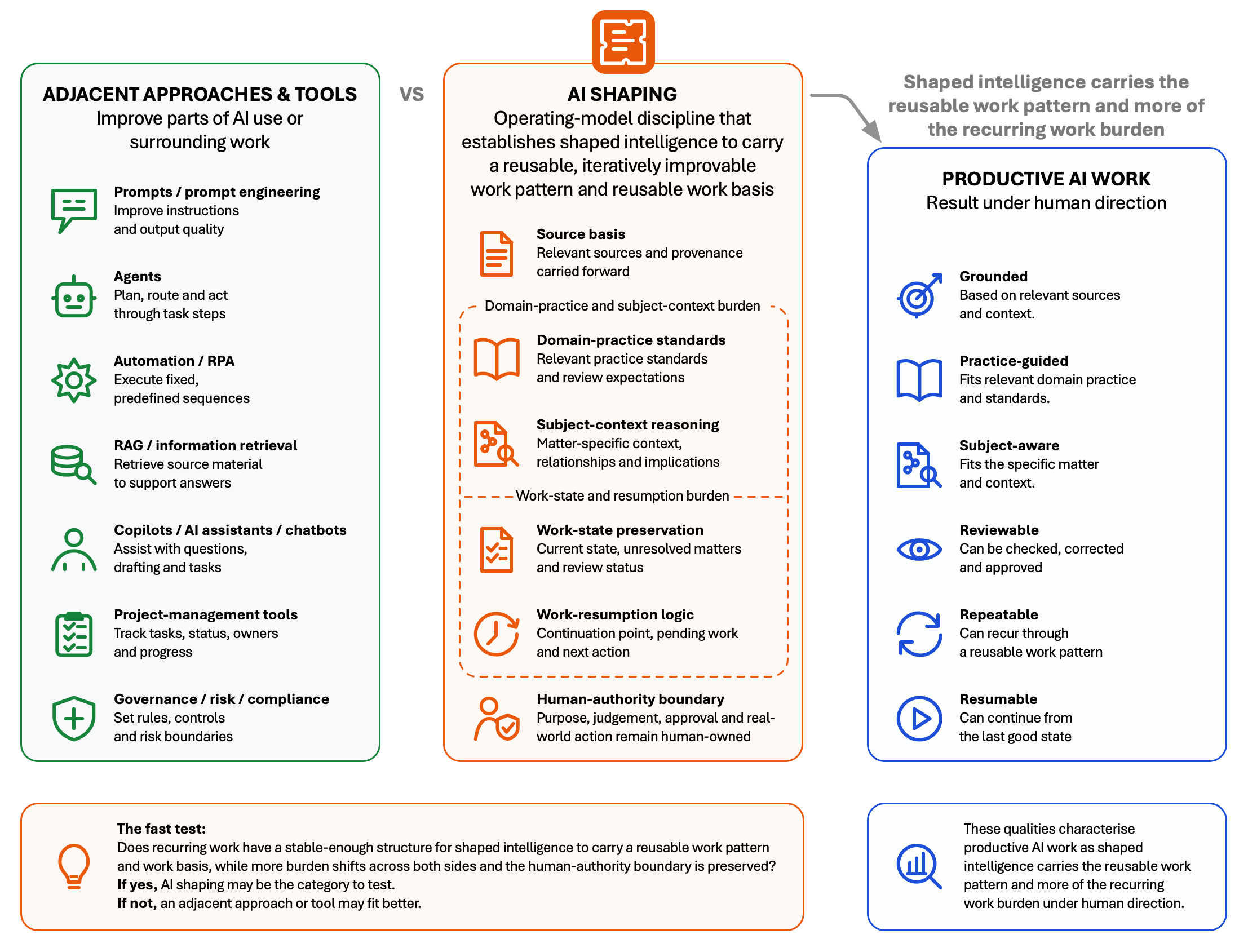
AI shaping vs prompts, agents, automation and workflow tools
Prompts, retrieval, copilots, agents, automation and workflow tools can improve parts of AI use. AI shaping addresses a different question: whether shaped intelligence carries a reusable and iteratively improvable domain work pattern and reusable work basis so two-sided recurring burden can shift while source basis and human authority remain explicit.
Adjacent AI approaches and tools may improve parts of AI use. AI shaping adds a durable work-pattern mechanism and asks whether the operational effect is two-sided work-burden shift while source basis is carried forward and the human-authority boundary is preserved.
Use this page whenThe question names a tool or execution form: prompts, retrieval, copilots, agents, automation, workflow tools or model fine-tuning.
Choose another route whenThe question concerns construct classification, work-development patterns or broader governance and adoption frameworks.
A comparison shortcut
This page answers one reader task: “How is AI shaping different from adjacent AI categories?” It gives the comparison route only. The category definition paper remains the formal source for category definition; the two capability evidence papers remain the formal sources for their distinct public-stage evidence objects.
Comparison at a glance
Read the difference by work object: what kind of work the category is trying to carry, control or produce.
Comparison at a glance
Adjacent category
Usual focus
AI shaping difference
Where to read next
Prompt engineering
Improving an individual instruction, answer, draft or exchange.
AI shaping is broader than the prompt. It shapes the recurring work pattern and asks whether more two-sided recurring work burden can move to shaped intelligence while sources and human authority remain explicit.
Planning, routing or acting through task steps with some degree of autonomy.
AI shaping does not require an autonomy claim. It keeps judgement, approval, disclosure, escalation, communication and real-world action human-owned while shifting recurring work burden into shaped intelligence.
AI shaping is most relevant when the work recurs but varies, so quality depends on changing context, sources, unresolved matters and review state rather than a fixed flow alone.
Retrieving or grounding answers in a document set or knowledge source.
Retrieval may supply source material. AI shaping asks whether shaped intelligence carries more of the two-sided recurring burden through a reusable work basis while source basis and human authority remain explicit.
A helper interface for asking questions, drafting, summarising or performing tool-assisted tasks.
AI shaping is not a user-interface category. The test is whether two-sided recurring work burden shifts into shaped intelligence while the human-authority boundary remains intact. Work burden shifts; accountability does not.
Tracking tasks, statuses, owners, dates, artefacts and project records.
Project-managing shaped intelligence is not a project-management platform. It carries more of the interpretation, sequencing, unresolved-matter framing, dependency/risk framing, project-state preservation, work-resumption logic and communication-preparation burden.
Changing model behaviour through training or weight-level adaptation.
The public AI-shaping claim does not depend on changing trained weights. It concerns the work pattern, work state, source basis, review route and human-directed operating model around general-purpose AI capability.
Governance, AI management systems, enterprise adoption, workflow redesign and productivity evaluation answer broader organisational or evaluative questions. Use AI shaping and adjacent AI frameworks for that context. This page remains focused on prompts, retrieval, copilots, agents, automation, project-management tools and model fine-tuning as execution forms or technical categories.
AI-work pattern comparison
How the work develops is a separate question
Specification-led AI work and Iterative AI work describe how AI-enabled work develops. They are not substitutes for prompts, agents, automation or AI shaping. Either pattern can use those tools, and AI shaping can operate across both.
Fast test
When the distinction matters
The AI output is useful, but someone still rebuilds the work basis every time.
The work recurs, but it varies too much for a fixed automation sequence alone.
Quality depends on domain-practice standards, subject-context reasoning and reviewable sources.
Pause, handover, escalation or personnel change creates context-loss risk.
Human judgement, approval, communication and real-world action must remain explicit.
Scope
What this page does not decide
This page settles the category-comparison question only. It does not assess public capability evidence, implementation readiness, deployment assurance or method transfer.
Use the public evaluation route when the next question is whether the bounded public evidence justifies protected-stage discussion.
Plain example
A chatbot may summarise three tickets. A retrieval system may find relevant notes. A workflow may move a task to the next stage. AI shaping asks whether shaped intelligence can carry more of the recurring domain-practice, subject-context, work-state and resumption burden while source basis and the human-authority boundary remain explicit.
Public boundary
This page is public-stage positioning material only. It supports category comparison; it is not a performance ranking or implementation guide.
Governed automation is not autonomous product management
In Product-managing shaped intelligence, governed automation means AI carries recurring product-state, routing, sequencing, reconciliation and resumption work through accepted controls, with every consequential result subject to human review and acceptance.
It differs from a one-off prompt because the work basis and state persist; from ordinary deterministic automation because judgement-bearing coordination remains reviewable and adaptable; and from autonomous agents because human product ownership retains purpose, value, priorities, scope, architecture decisions and acceptance while stewardship and decision authority retain continuity, disclosure, publication, deployment and consequential action.