AI shaping evidence starts with visible work-burden shift
Public evidence asks whether the durable shaped-capability mechanism produces a visible operational effect: more two-sided recurring work burden carried by shaped intelligence while source basis and human authority remain explicit. Evidence strength depends on the bounded instance, not the diagram or wording alone.
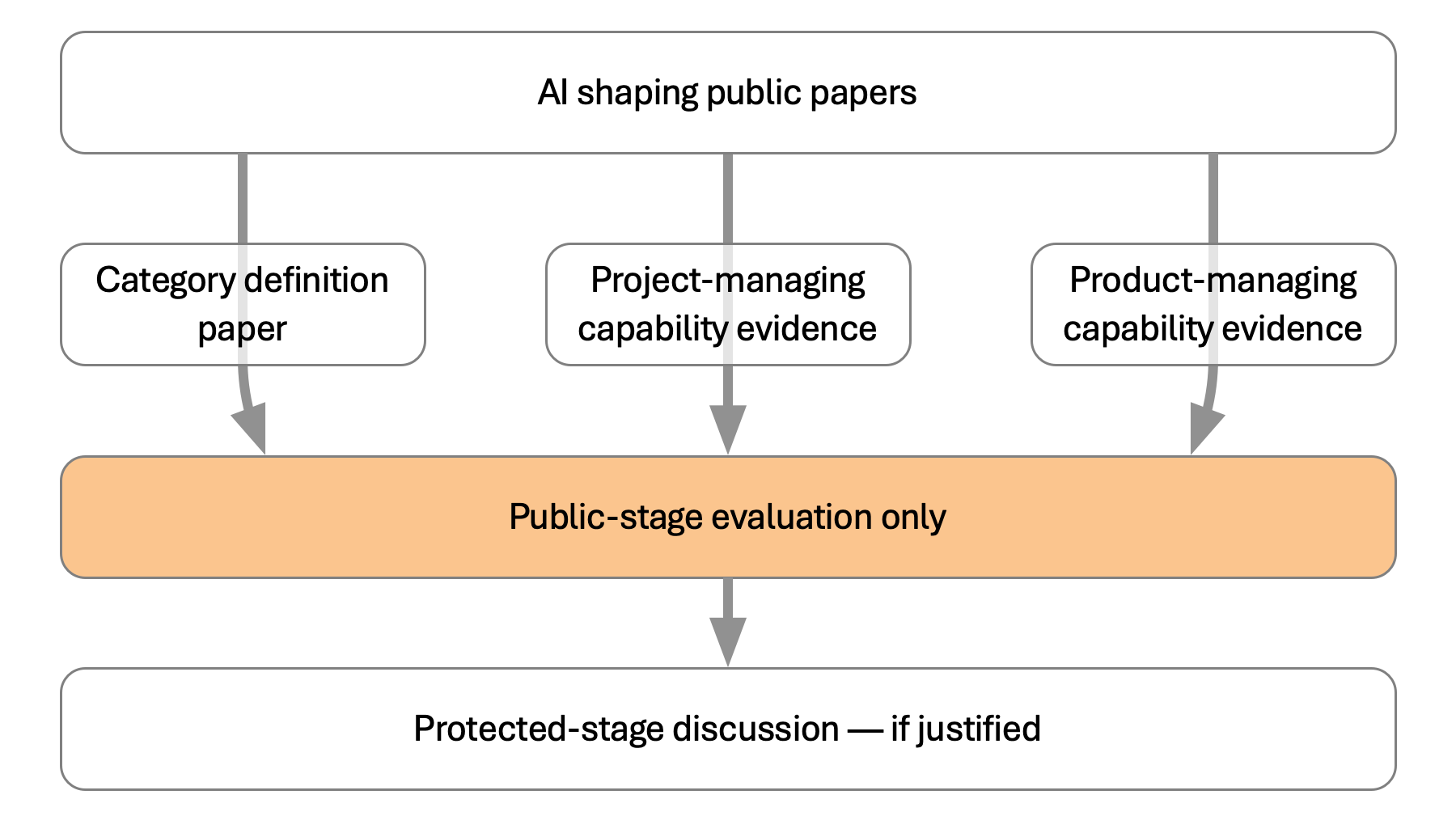
The evidence route keeps public-stage evaluation separate from protected-stage implementation review.Evidence status overview
Three evidence positions with different authority
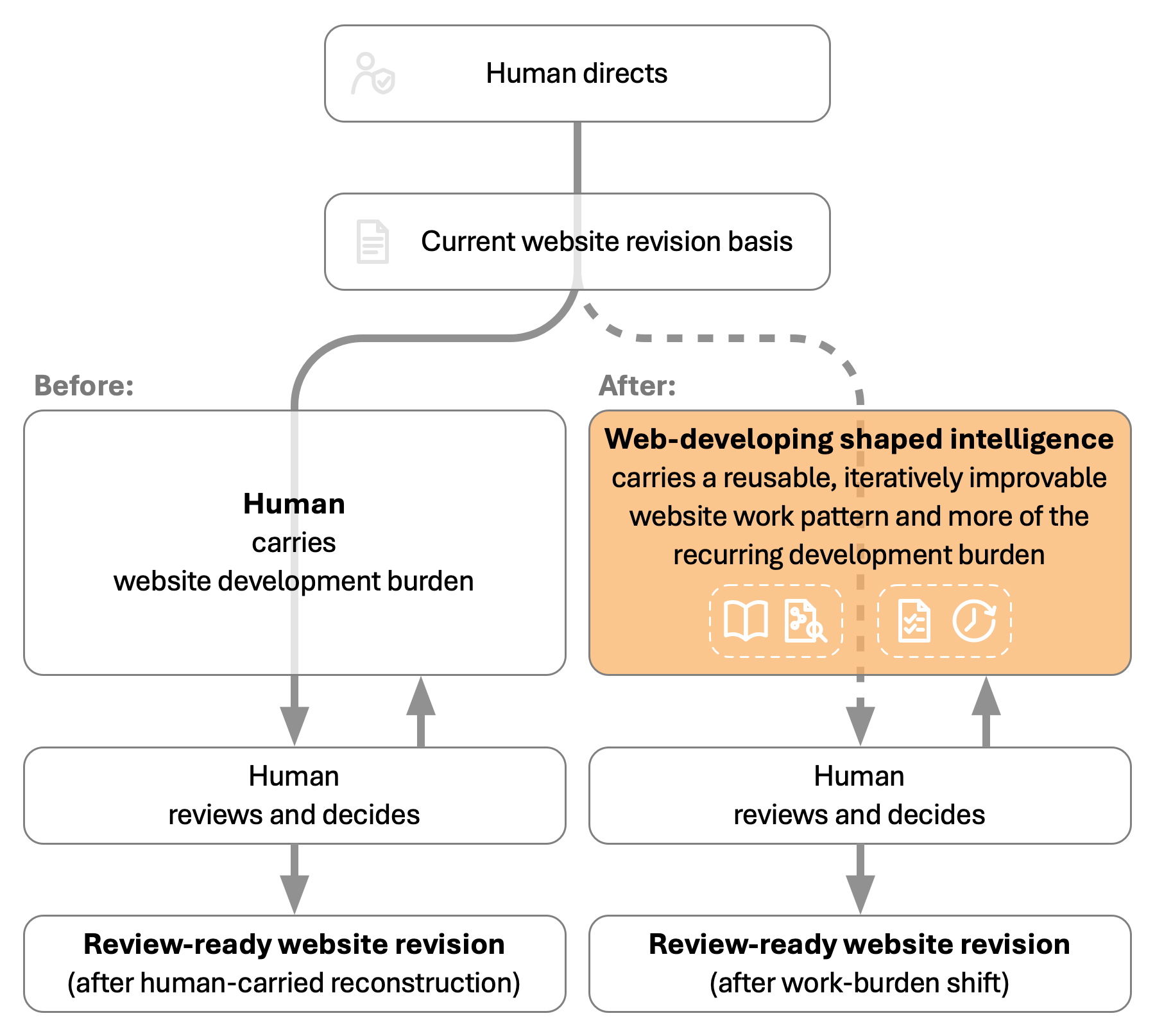
Project-managing shaped intelligence and Product-managing shaped intelligence now have distinct DOI-backed formal capability-evidence papers. The Project-managing paper evaluates the mediated project-work instance; the Product-managing paper evaluates the bounded direct-shaping product instance. Public web-developing shaped intelligence remains a bounded, readily inspectable website-specific evidence instance established through the direct-shaping approach.
The roles are complementary, not interchangeable. The separate product-ownership page is a human-authority account, not another evidence role. The Category Definition paper retains formal category authority; each Capability Evidence paper controls its own evidence object and limitations.
Evidence status
Read status before strength
These labels identify source and maturity; they are not scores or claims that one route proves the others.
Public orientationConcept and mechanism pagesExplain the category and reader route; they do not create capability evidence.
Bounded public evidencePublic web-developing shaped intelligenceShows observable work-burden shift in a readily inspectable website-specific instance.
Formal published evidenceProject-managing Capability EvidenceThe current published paper evaluates the distinct mediated-shaping project-work instance.
Formal published evidenceProduct-managing Capability EvidenceThe current published paper evaluates the bounded direct-shaping product instance using retrospective first-party evidence.
Planned directionFuture capability evaluationsPlanning context does not establish a capability or evidence result.
Not establishedQuantified or independent effectNo public burden-reduction percentage, controlled productivity result or independent validation is claimed.
Evidence in brief
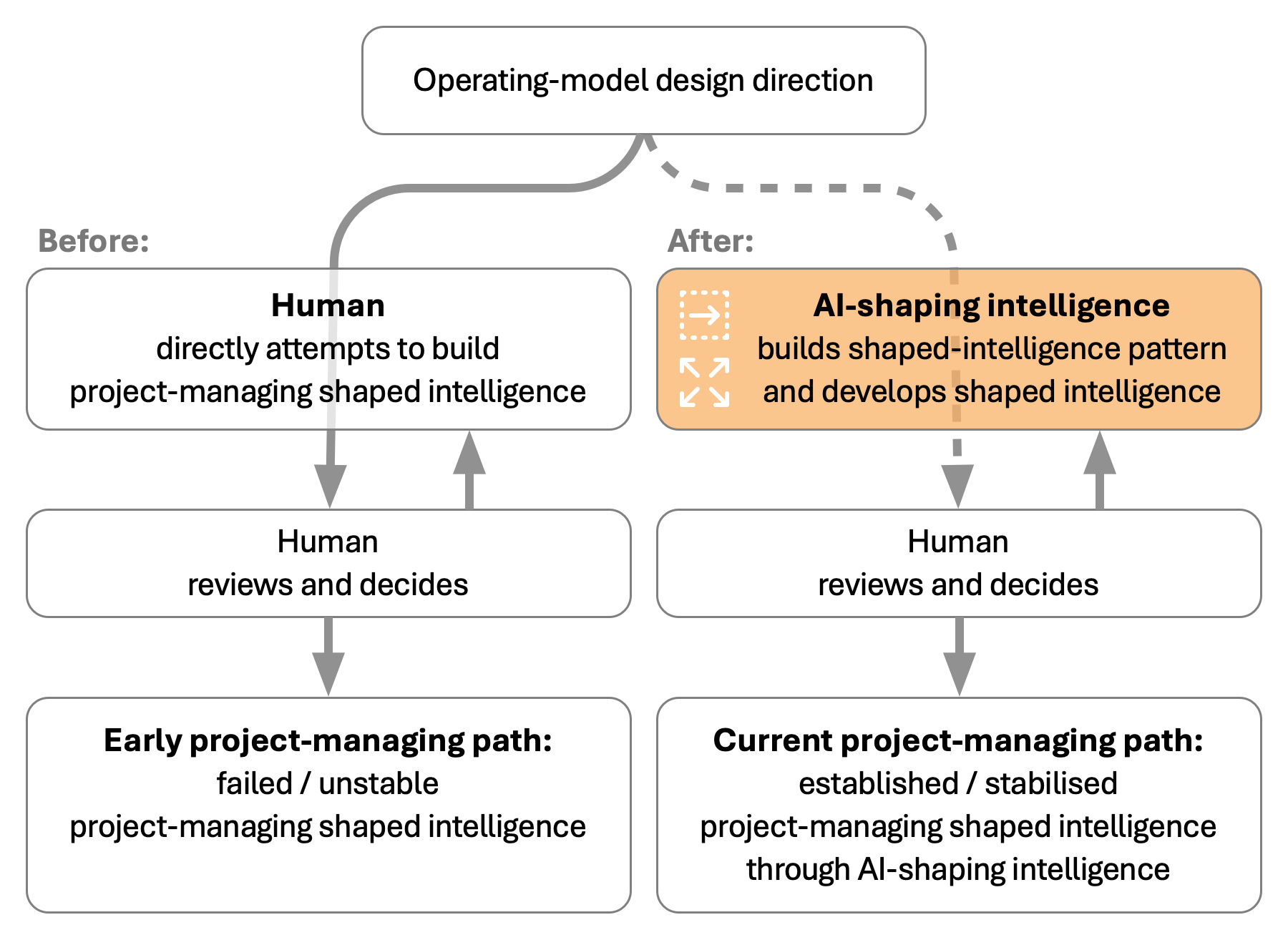
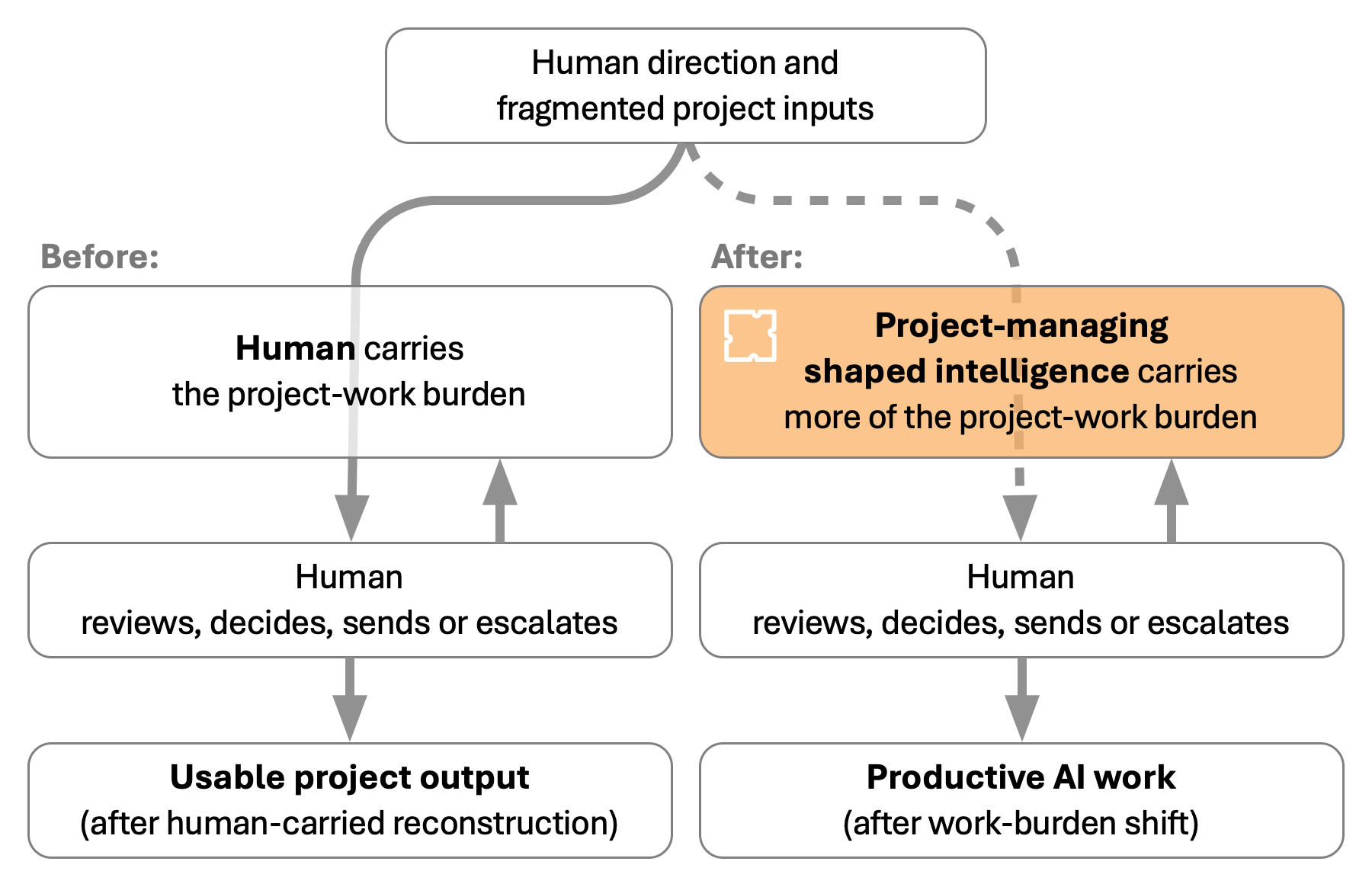
The diagrams answer progressively harder questions. Public web-developing shaped intelligence makes the burden-shift mechanism easy to see. The capability-architecture diagram locates Product-managing publication coordination, publication co-evolution and the separately governed Project-managing integration boundary. AI-shaping intelligence shows the reusable shaping capability. Project-managing shaped intelligence shows the mediated project-work instance. The two Capability Evidence papers remain the distinct formal evidence objects for Project-managing and Product-managing shaped intelligence.
The diagrams give public-safe before/after views. They show observable capability relationships and burden shift without disclosing implementation mechanics, providing deployment assurance, proving reproducibility or authorising method transfer.
Public web-developing shaped intelligence. A bounded, readily inspectable website-specific instance: more recurring website development burden moves to shaped intelligence while human direction, review and decision remain explicit.AI Shaping capability architecture. Orientation only: the diagram locates Product-managing publication coordination, reciprocal refinement, retired private paper-authoring as historical evidence rather than a current capability, and separately governed Project-managing integration through the singleton Launcher. It does not by itself establish capability evidence. Open the full-resolution diagram.AI-shaping intelligence. The reusable shaping-capability instance: it develops and renews its shaping pattern and uses that pattern to develop shaped intelligence under human direction. The diagram shows the public relationship only, not the protected method.Project-managing shaped intelligence. The formally published mediated-shaping capability-evidence instance: fragmented project inputs become productive AI work when more of the project-work burden shifts to project-managing shaped intelligence while human authority remains explicit. The separately published Product-managing paper evaluates a bounded product-level instance.
Public evidence roles at a glance
Public evidence roles at a glance
Public evidence role
Public role
Boundary
Website-specific capability example
Shows an instance established through the direct-shaping approach with visible two-sided work-burden shift in recurring website development and revision.
A bounded instance established through the direct-shaping approach on this website; it is outside the capability paper's structured evidence package and does not evidence AI-shaping-intelligence domain transfer.
Product-managing shaped-intelligence evidence
Supports the bounded classification that Product-managing shaped intelligence is operationally mature within the AI Shaping knowledge and publication product; repeated accepted operation also shows observable but unquantified coordination value and work-burden shift.
The published Capability Evidence paper contributes a limited first-party direct-approach argument only. It does not establish quantified effect, sole causation, independent validation, replication, autonomy, generic transferability, universal Product-management capability, complete Scrum practice or general direct-shaping superiority.
Reusable shaping-capability evidence
Shows the mediated-shaping approach through AI-shaping intelligence: vendor-evaluating shaped intelligence was developed and then extended into broader project-managing shaped intelligence.
Supports bounded public-stage evaluation of the reusable shaping capability; public pages do not disclose its protected implementation mechanics.
Primary project-managing capability evidence
Shows visible work-burden shift in real project and BAU IT support contexts with materially greater work-state and resumption burden.
Shows how later protected-stage evaluation could frame target-domain rematerialisation into a different work domain.
Does not create an investment-domain capability claim, financial advice or implementation authority.
Evidence–plan boundary
Planned directions are not additional evidence roles
The three planned capability directions sit outside the current public evidence package. Naming a planned direction does not create a capability claim, evidence stream or transfer result.
What would not be enough evidence?
Useful one-off AI output, a polished demo, a private implementation description by itself, or an illustrative transfer map without visible burden-shift evidence would not be enough. The public question is narrower: whether the available evidence shows reviewable work-burden shift under human authority, while leaving implementation-level review to protected-stage discussion.
Choose the evidence page that matches the question
Choose the evidence page that matches the question
Question
Use this page
Public-safe role
What is the most readily inspectable public work-burden-shift example?
Shows a bounded website-specific capability instance and connected work across content, information architecture, interface and visual design, front-end implementation, publishing and validation.
How does Product-managing shaped intelligence coordinate publication work within the broader capability architecture?
Explains the product-level coordinating capability, repeated accepted cycles, three current publication capabilities, publication co-evolution and the governed integration boundary with separately governed Project-managing shaped intelligence under human authority.
What product responsibilities did Kurni Kwok retain while AI carried recurring delivery work?
Routes to the formal publication, DOI and citation details for the bounded direct-shaping product-level evidence object.
Why this index is separate from the papers index
The papers index is for publication access and citation. This evidence overview is for website navigation: it tells readers which evidence page to use before they open the relevant formal Capability Evidence paper. Use About for the development provenance and author context behind the evidence.
Why this index is not a substitute paper
This overview may route to website-specific and integrated publication-system evidence, but it does not replace the formal papers or present private material as publicly inspectable. Each Capability Evidence paper remains the formal source for its own bounded evidence object and limitations.
Public boundary
This page supports bounded public-stage capability evaluation only. It does not establish deployment readiness or disclose the protected method. Implementation-level review belongs in Protected-stage discussion.