AI shaping in 5 minutes: from one-off prompts to reusable work patterns
The simple version: recurring work often has enough underlying structure to be shaped even while the subject, evidence and work state change. AI shaping establishes a reusable and iteratively improvable domain work pattern and reusable work basis so shaped intelligence can carry more of the recurring work while sources and human authority stay explicit.
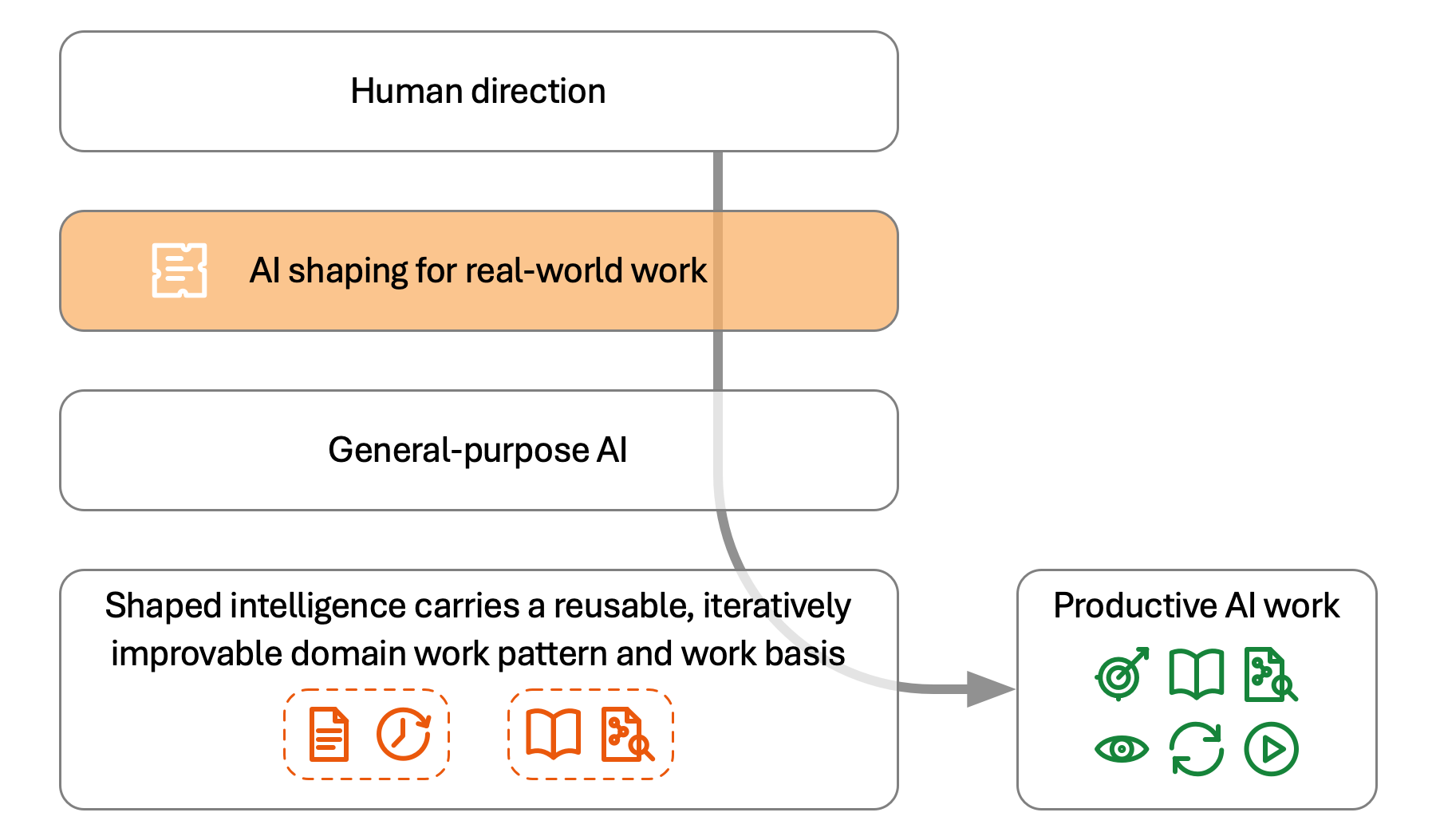
The simplest view: AI shaping establishes shaped intelligence that carries a reusable and iteratively improvable domain work pattern and reusable work basis. More recurring burden can then shift to shaped intelligence and the result can become grounded, practice-guided, subject-aware, reviewable, repeatable and resumable productive AI work under human direction.
This page gives the shortest public explanation. Use the AI shaping concept page for the complete website architecture, the Evidence overview for public-stage evaluation and the papers index for formal DOI-backed sources.
What the diagram means
The burden carried by the work is what changes
AI shaping is the operating-model discipline for establishing shaped intelligence that can carry a reusable and iteratively improvable domain work pattern and reusable work basis. It may establish shaped intelligence through either the direct-shaping approach or the mediated-shaping approach. In both approaches, two-sided work-burden shift is the operational effect: shaped intelligence carries more of the recurring burden. The two sides are domain-practice standards plus subject-context reasoning, and work-state preservation plus work-resumption logic. The result can become productive AI work: grounded, practice-guided, subject-aware, reviewable, repeatable and resumable under human direction.
Use this plain guide to understand the practical problem before the formal terms. Glossary popovers support quick term lookup; the papers hold the formal record and Protected-stage discussion holds the implementation-level boundary.
Plain example
One recognisable situation
You have a support-ticket export, a vendor email, a few shorthand notes and a stakeholder asking what is happening. Ordinary AI might summarise each item. The harder work is keeping the source basis visible, separating progress from unresolved matters, naming what needs review and preparing the next communication without pretending the human has already decided.
AI shaping aims at that second problem. It helps the work continue from a preserved, reviewable state instead of forcing the person to recreate the whole situation in a new prompt.
The problem in plain terms
General-purpose AI can produce useful output, but complex or extended work often fails because every new exchange starts without enough of the job: context, source basis, domain-practice guidance, subject-specific context, prior decisions, unresolved matters, review status and next action.
In practical terms, the person keeps rebuilding the long prompt. The repeated work also includes applying domain-practice expectations and subject-context reasoning, not just restating background information. AI shaping targets that repeated burden by establishing a reusable and iteratively improvable domain work pattern and reusable work basis that shaped intelligence can carry forward.
Two-sided work-burden shift: more domain-practice and subject-context burden, and more work-state and resumption burden, move from the responsible person to shaped intelligence. Source basis is carried forward and the human-authority boundary remains explicit.
Ordinary AI use and AI shaping
Ordinary AI use
The person asks for a summary, draft or analysis. The output may be helpful, but the person still has to rebuild the work context, check what is unresolved, decide what can be used, and restart the pattern again after the next pause or new input.
AI shaping
The work pattern is shaped and the reusable work basis is arranged so shaped intelligence can work from the relevant source basis, domain-practice guidance, subject-specific context, review boundaries, output expectations and preserved work state. In simple terms, the work does not depend on improvising from a fresh prompt each time. The person still supplies direction, reviews, approves, escalates, communicates and takes real-world action.
Shape the work, then carry it forward
Shaping
Shape how the recurring work should run
Arrange the role, source relationship, domain-practice expectations, subject-context reasoning, review boundaries and output expectations so the AI contribution fits the work instead of behaving like a fresh one-off answer.
Reusable work basis
Carry the work forward
Shaped intelligence carries source basis, relevant practice standards, matter-specific context, current work state and resumption logic into recurring work, so new information can be digested without starting again from scratch.
The core value proposition
AI shaping is the operating-model discipline for establishing shaped intelligence that carries a reusable and iteratively improvable domain work pattern and reusable work basis. Two-sided work-burden shift is the operational effect; productive AI work is the grounded, practice-guided, subject-aware, reviewable, repeatable and resumable outcome under human direction.
Four core terms after the value is clear
Four core terms after the value is clear
Term
Plain role
Read next
AI shaping
The operating-model discipline for turning general-purpose AI capability into productive AI work.
The reusable shaping capability that applies AI shaping through self-shaping and domain-shaping, then uses its shaping pattern to develop shaped intelligence.
The public evidence layer separates a bounded, readily inspectable website-specific instance from two distinct formally published capability-evidence objects. Public web-developing shaped intelligence makes the burden shift easy to inspect. Project-managing shaped intelligence evaluates the mediated project-work instance through AI-shaping intelligence; Product-managing shaped intelligence evaluates the bounded direct-shaping product instance. The reading route runs through the evidence overview, the relevant paper and the public evaluation map.
This page is a public introduction, not implementation guidance or capability evidence. Use Protected-stage discussion for the full implementation-level boundary.
Use the Category Definition paper for the formal AI-shaping category, the Project-managing Capability Evidence paper for the mediated project-work instance and the Product-managing Capability Evidence paper for the bounded product instance.