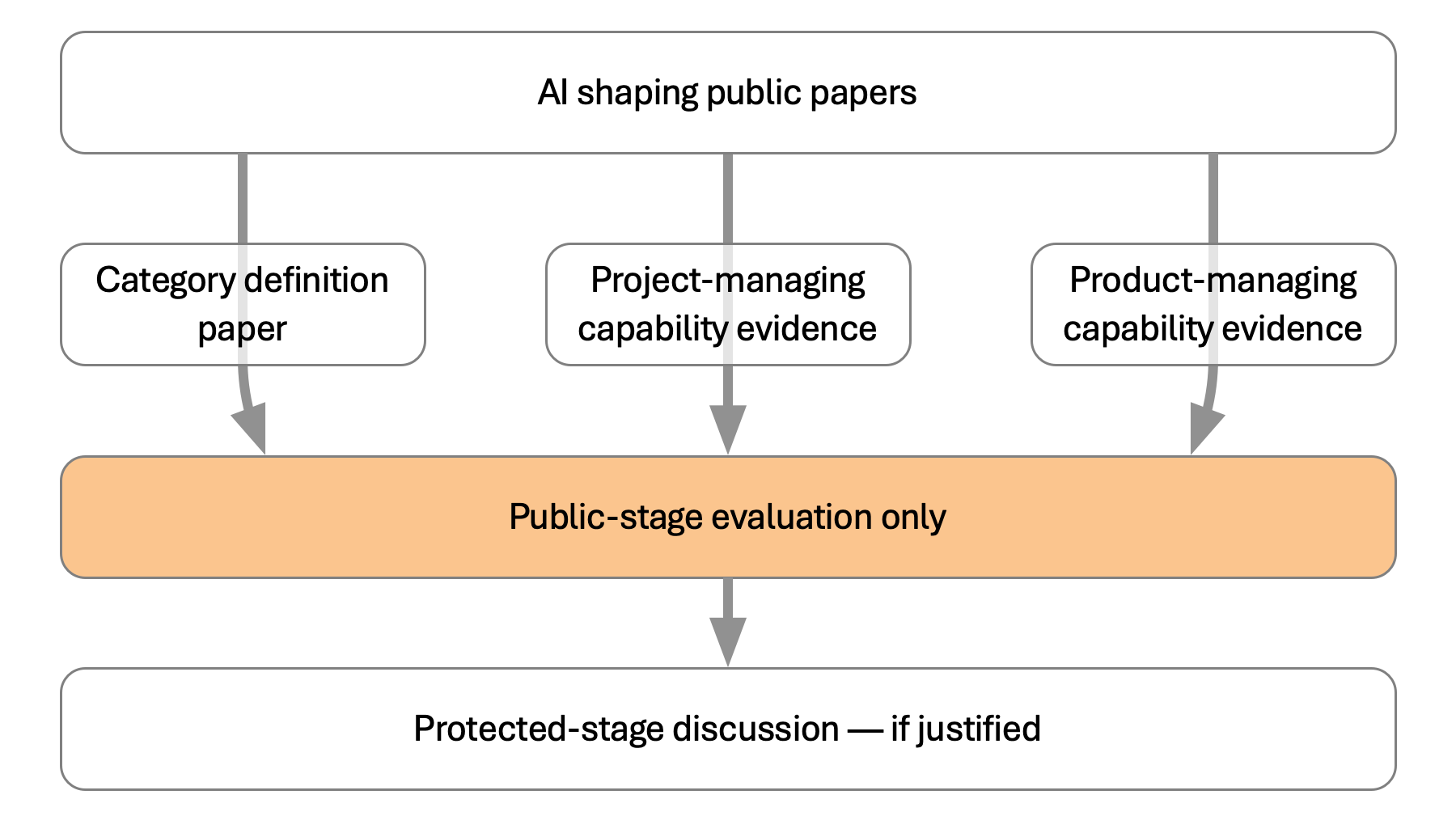
Public evaluation map: where public AI shaping evidence stops
A neutral route for reading the public AI shaping materials: what the concept pages, the three current separately governed publication capabilities, the bounded product operating architecture, evidence pages and three DOI-backed papers can show publicly, what each source is for, and where public-stage evaluation stops before protected-stage discussion.
Use this route to check source roles, allowed public conclusions and the stop point before protected-stage review. For the plain explanation, start with AI shaping in 5 minutes; use the DOI-backed papers for formal citation or evidence review.
Public-stage evaluation is the stop point for public material; implementation-level questions require protected-stage conditions.
Source authority, permitted conclusions and stop rules
The Evidence overview helps a reader choose an evidence object. This page answers a different question: which public source controls each claim, what conclusion it supports and where public review must stop.
Why this page exists
How explanation leads to bounded evidence
Product-managing shaped intelligence coordinates the AI Shaping knowledge and publication product across Private knowledge-publishing, Published paper-authoring and Public web-developing shaped intelligence. Publication co-evolution remains the controlled reciprocal refinement among those three current publication capabilities; retired Private paper-authoring remains historical/rollback evidence only. Human product ownership, stewardship and decision authority materially finalise scope and acceptance; one governed capability is active at a time; accepted results return through reconciliation; and no change propagates automatically.
Keeping those roles together prevents product coordination and reciprocal refinement from blurring evidence status: the operating architecture and public diagram are not, by themselves, generic capability evidence. The Product-managing Capability Evidence paper supplies a separate bounded first-party evidence object with its own limitations.
Boundary
Where the public route stops
The public pages and papers support category understanding and bounded public-stage capability evaluation only. They do not provide implementation guidance, deployment assurance, reproducibility proof, product-performance assurance, method transfer or commercial-use rights.
Reading route
Read the public materials in this order when the question is whether AI shaping is the relevant category and whether the public evidence justifies protected-stage discussion.
Reading route
Step
Public question
Use
Stop rule
1.Problem
Is the issue only useful AI output, or is the person repeatedly rebuilding context, practice expectations and subject reasoning before the work can continue?
Do not treat category understanding as capability evidence or implementation transfer.
3.Mechanism
What two-sided work burden — domain-practice and subject-context burden, and work-state and resumption burden — is meant to shift from the person to shaped intelligence?
Is there enough visible public evidence, including the four-capability publication-product operating architecture where relevant, to justify considering a deeper scoped question?
Provides the bounded public-stage evidence package for project-managing shaped intelligence and visible two-sided work-burden shift, including domain-practice application, subject-context reasoning, work-state preservation and resumption.
Not deployment assurance, reproducibility proof, product-performance assurance or implementation reliance.
Routes readers from the readily inspectable website instance through integrated publication-system evidence and the mediated project evidence route through AI-shaping intelligence.
Not a substitute paper and does not create an additional evidence stream in the capability paper's structured evidence package.
Provides a bounded, readily inspectable website-specific evidence instance established through the direct-shaping approach of visible two-sided work-burden shift across successive revisions of this website.
Outside the capability paper's structured evidence package; not a generic or cross-site website-development capability and not evidence of AI-shaping-intelligence domain transfer.
Explains Product-managing shaped intelligence as the bounded product-level coordinator, the three current separately governed publication capabilities, one-active-capability control and publication co-evolution through reciprocal refinement.
The product-level capability is operationally established only within this bounded product rather than established as generic capability evidence; the page does not disclose private controls, imply autonomous coordination or alter formal paper conclusions.
Connects the Project-managing paper to the distinct formally published mediated-shaping capability-evidence instance in project and BAU IT support contexts.
Not a project-management product page or unrestricted domain-transfer claim.
Presents three planned shaped-intelligence directions with the same public claim status while preserving distinct transfer, extension and dependency relationships.
Planning context only; not current capability evidence, implementation commitment or authority to rely on a capability.
How to evaluate Product-managing shaped intelligence publicly
Check whether the visible record shows accepted product state, correct complete-definition-owner selection, one-active-capability routing, separate surface authority, human acceptance, reconciliation and accepted receiving-surface outcomes across three cycles.
The allowed public conclusion is initial bounded evaluation and operational establishment within this product. Stop before claiming quantified burden reduction, measured productivity improvement, independent validation, autonomy, generic transferability, universal Product-management capability, complete Scrum practice or deployment assurance. Use the Product-managing Capability Evidence paper for the formal evidence object and AI Shaping product ownership for the distinct human-authority account.
What a reader may conclude publicly
The public material is designed to support limited conclusions only.
What a reader may conclude publicly
If the reader wants to know...
Use...
Public conclusion allowed
What AI shaping means
The plain guide, concept pages and category definition paper
Whether AI shaping is a relevant category for a practice-guided, subject-aware work-burden problem.
That Product-managing shaped intelligence is operationally established within this bounded product, supported across repeated accepted cycles; the three-cycle maturity gate remains satisfied while it coordinates three current separately governed publication capabilities through sequential reciprocal refinement under retained human authority. This does not establish generic transferability or generic or independently validated Product-management capability.
How to implement, reproduce or transfer the method
Not the public materials
No implementation-level conclusion; protected-stage conditions are required before any deeper review.