Operating-model design arranges how AI-enabled work should run
Operating-model design is the central design activity and work-system lens for AI shaping. In AI shaping, it arranges the source basis, the conditions for two-sided work-burden shift and the human-authority boundary around recurring AI-enabled work.
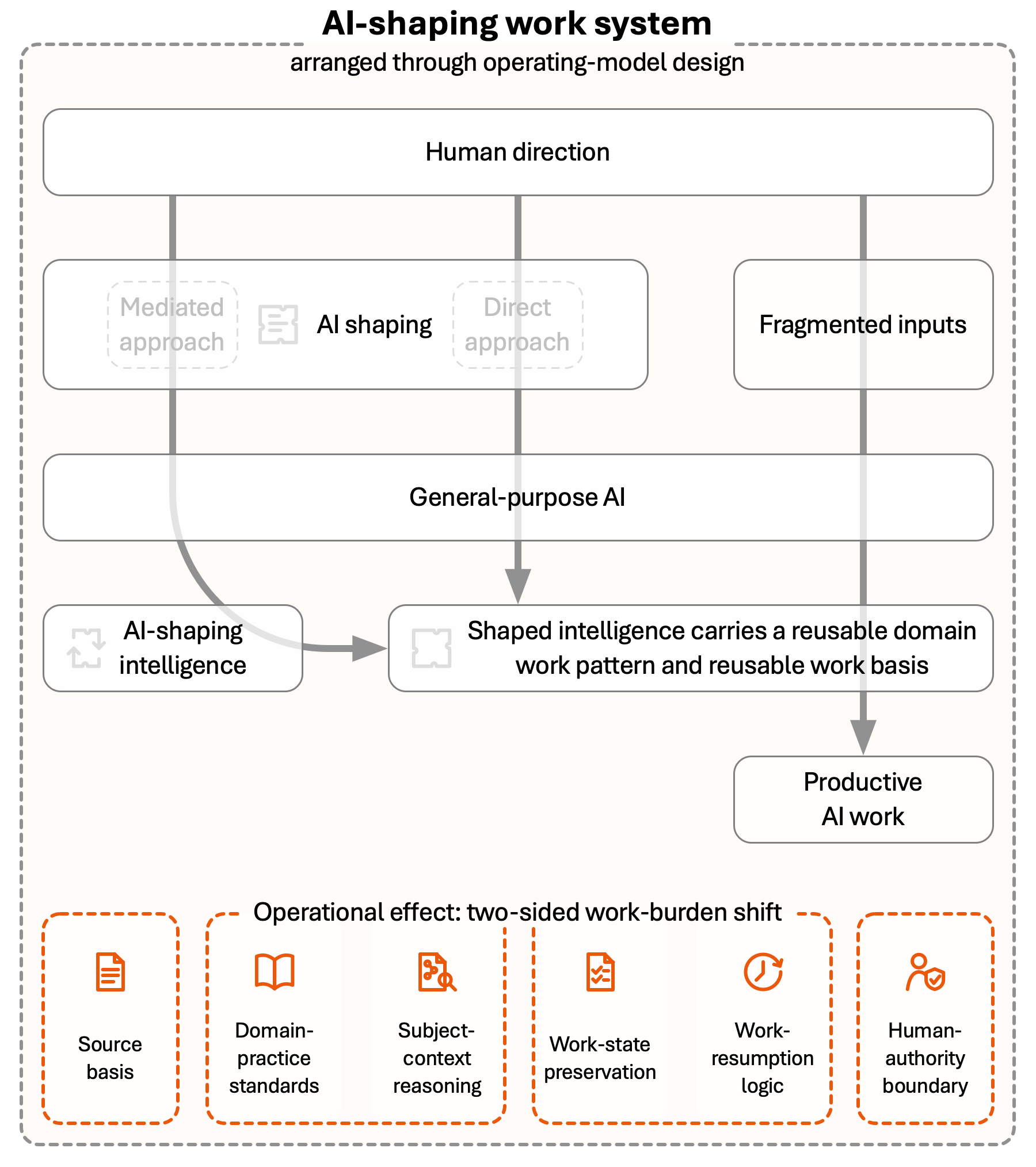
The AI-shaping work system is arranged through operating-model design. Under human direction, AI shaping establishes shaped intelligence through either the direct-shaping approach or the mediated-shaping approach through AI-shaping intelligence; shaped intelligence carries the reusable and iteratively improvable domain work pattern and reusable work basis.
What operating-model design arranges
The work-system architecture has one grounding condition, four burden components grouped into the two formal burden sides, and one governing boundary. Operating-model design arranges how those elements work together around recurring AI-enabled work. The icons in the Element column repeat the six architecture elements shown along the base of the diagram.
What operating-model design arranges
Architecture role
Element
What operating-model design arranges
Grounding condition
Source basis
Relevant sources and provenance carried forward. The operating model defines how that basis remains visible and usable through recurring work.
Domain-practice and subject-context burden
Domain-practice standards
Methods, standards and review expectations. The operating model arranges how they shape recurring work.
Domain-practice and subject-context burden
Subject-context reasoning
Matter-specific context, roles and perspectives. The operating model arranges how they enter the work.
Work-state and resumption burden
Work-state preservation
Current state, unresolved matters and review status. The operating model arranges how they are preserved.
Work-state and resumption burden
Work-resumption logic
Continuation point, pending work and next action. The operating model arranges how work resumes.
Governing boundary
Human-authority boundary
Judgement, approval and real-world action remain human-owned. The operating model keeps that boundary explicit.
Cross-cutting design controls
The canonical architecture above does not remove two broader design concerns. They operate across the work system rather than as additional burden components.
Cross-cutting design controls
Cross-cutting control
Design role
Role and capability boundaries
Clarify what broad AI capability, shaping capability, domain-facing shaped intelligence and the responsible person each carry.
Review boundaries and controls
Clarify source-use expectations, validation, review, continuation and stop conditions across the work system.
Work-system lens
Use this page for the operating-model view
This page elaborates the operating-model structure compressed into the middle column of the comparison page. The design question is what must be arranged so shaped intelligence can carry more two-sided recurring work burden without losing source basis or the human-authority boundary.
Use it to see how the concept pages fit together inside one work system: AI shaping names the discipline; operating-model design is the central design activity; direct- and mediated-shaping approaches are alternative structural arrangements; work-burden shift is the operational effect and primary evidence signal; AI-shaping intelligence and shaped intelligence are reusable capabilities; and productive AI work is the outcome.
Product-managing shaped intelligence across publication capabilities
The bounded product-management capability arranges accepted state, complete-definition ownership, priority, dependency, one-active-capability sequencing, stopping, human review and resumption across three current separately governed publication capabilities.
Operating-model design is the central design activity and work-system lens that arranges source basis, the conditions for two-sided work-burden shift and the human-authority boundary around recurring AI-enabled work.
In plain English: it is the design of how work should run when AI capability becomes part of the work pattern, not just the choice of which AI tool to use.
Why this term is needed
The problem is not only model capability or output quality. The harder question is how work should be arranged so relevant sources and domain practice enter the work, matter-specific reasoning and work state are carried, work can resume, and the human-authority boundary remains intact.
Construct classification
How discipline, operating model, framework and method differ
This page stays focused on the work-system design. The separate construct-classification comparison explains why AI shaping is a discipline and how operating model, framework, method, approach, mechanism, capability and outcome are used in the public architecture.
Example
A work system that carries source basis forward, applies domain-practice standards and subject-context reasoning, preserves work state and resumption logic, and keeps judgement, approval and real-world action human-owned.
Non-example
Adding AI to a workflow without arranging the source basis, the two burden sides or the human-authority boundary around recurring work.
Assessment signal
A credible operating-model design should make clear what source basis is carried, which two-sided burdens shaped intelligence carries, how work resumes and how the human-authority boundary remains intact.
Public work-system explanation only: this page explains what the operating model arranges; it does not provide implementation design guidance or method transfer. For the full stop rule, use Protected-stage discussion.