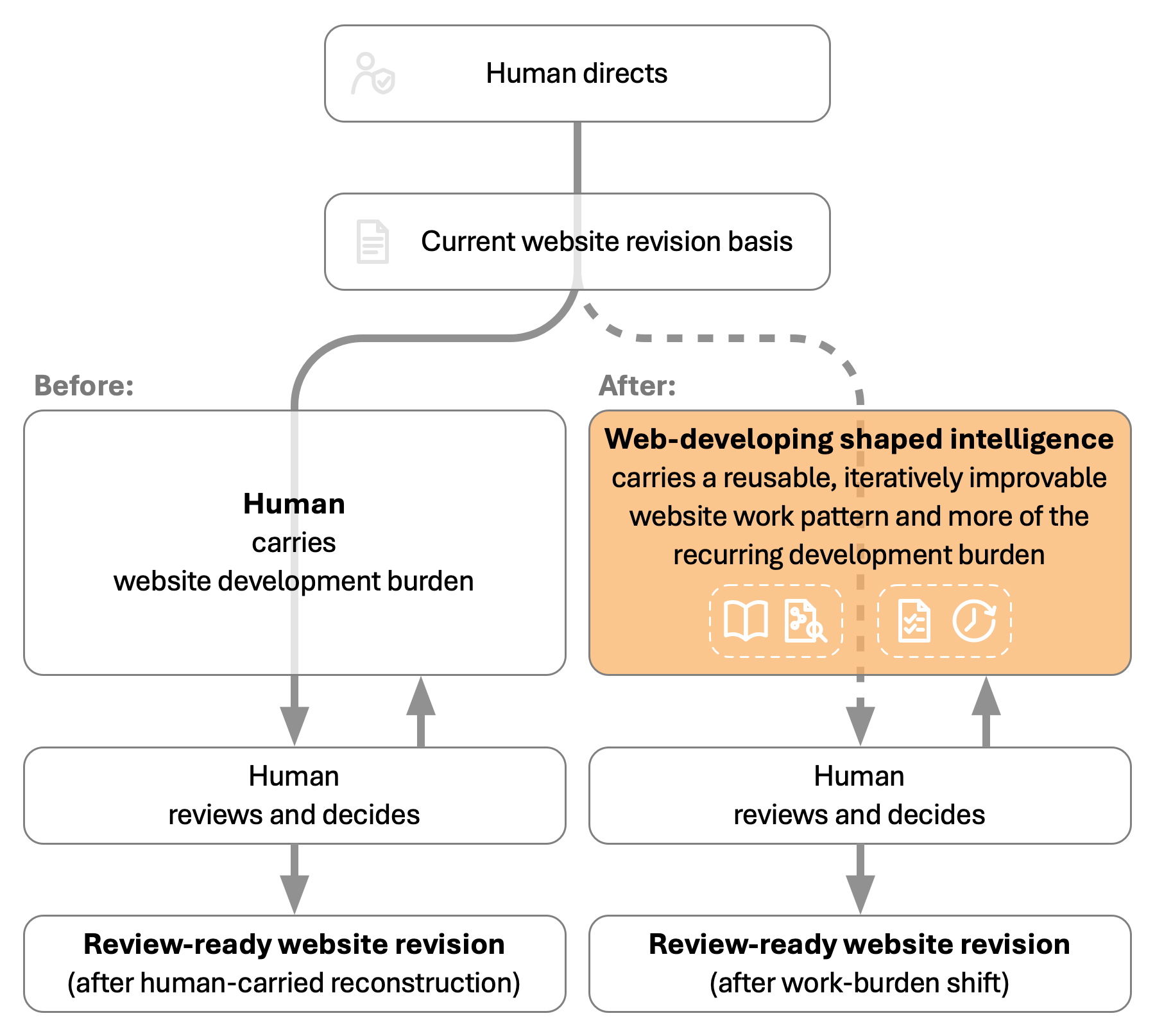
Public web-developing shaped intelligence carries website work
Public web-developing shaped intelligence is a bounded, website-specific domain-facing capability established through the direct-shaping approach for the recurring development and revision of this website. It carries more connected content, information-architecture, interface-design, visual-direction, front-end, publishing and validation burden while I establish purpose and direction, supply context, review and challenge the work, authorise revisions and decide what is published.
Public web-developing shaped intelligence. The visible change is burden allocation: more recurring website development burden moves to shaped intelligence while human direction, review and decision remain explicit.Visible example
Why this is easy to see
I direct this website as a connected work system rather than manually editing every HTML, CSS, JavaScript and prose change. I identify the problem or desired change, establish direction and constraints, review and challenge the resulting analysis, wording, design and implementation, authorise revisions and decide what is published.
Public web-developing shaped intelligence carries more of the connected content, information-architecture, interface-design, visual-design, front-end implementation, publishing and quality-control work into review-ready form. This makes the operating-model, editorial, design, implementation and validation capability publicly inspectable rather than presenting only a finished site. The before/after comparison is readily visible: more recurring burden is carried forward without the human rebuilding the site-specific work basis before each revision can move forward.
What website-development burden is carried
Website development here is treated as one connected work surface, not only code, technical SEO or isolated page production. The observable burden spans the following functional areas; these labels describe the work and do not add concepts to the canonical AI-shaping architecture.
Content, copy and information architecturePage purpose, reader routes, information hierarchy, navigation, internal linking, public copywriting and editorial revision, canonical terminology and cross-page harmonisation.
Interface and responsive designComponent selection, layout, visual hierarchy, interaction behaviour, mobile treatment, dark-mode behaviour and accessibility.
Visual and graphic directionIcon and diagram concepts, visual semantics, composition, placement and asset-integration requirements. Final asset production may remain human-executed where exact consistency or manual control is required.
Front-end implementationReview-ready HTML, CSS and JavaScript revisions, including technical discovery and integration across the static site.
Publishing and quality controlSEO, metadata, structured data, sitemap and social-preview alignment, cross-page consistency, rendered visual and interaction review, validation and defect remediation.
How the work-system pattern appears on this website
The same six public work-system elements used across the AI-shaping architecture can be inspected across that broader website-development surface. The four burden components remain grouped into the two formal burden sides; source basis is the grounding condition and human authority remains the governing boundary.
How the work-system pattern appears on this website
Element
Architecture role
Observable website evidence
Source basis
Grounding condition
The latest accepted complete website revision basis is carried forward into each revision. It preserves the site-specific governing context together with the current website files and assets, so the work system does not have to be reconstructed from a generic brief.
Domain-practice standards
Domain-practice and subject-context burden
Relevant content-design, information-architecture, copywriting, editorial, interface, visual, SEO, accessibility, interaction, responsive-layout and static-site practice is assessed during revision. I do not establish the applicable website-practice criteria change by change.
Subject-context reasoning
Domain-practice and subject-context burden
The site's category architecture, canonical terminology, page roles, copy, visual semantics, evidence relationships and public/protected boundaries are interpreted in the context of the requested change. I do not restate those relationships page by page.
Work-state preservation
Work-state and resumption burden
The latest accepted complete website package preserves the current copy, components, assets, metadata, links, page relationships and prior implementation state. I do not provide a page-by-page reconstruction of the website before each revision.
Work-resumption logic
Work-state and resumption burden
Revision resumes from the latest accepted complete website revision basis and established site architecture. I do not reconstruct the preceding content, design and implementation path before the next authorised website problem can be analysed and carried forward.
Human-authority boundary
Governing boundary
Purpose, supplied context, judgement, review, approval, disclosure and publication decisions remain human-owned. I establish intended meaning and direction, challenge analysis, wording and design, approve human-produced final assets where applicable and decide what is published.
Human authority
I direct, review and decide
Public web-developing shaped intelligence carries more of the recurring website-development work. I identify problems, establish intended meaning and direction, direct scope, challenge analysis, wording, design and implementation, authorise revisions and decide what is published. Where I produce or refine a final visual asset for exact consistency, that execution remains human-owned. The capability does not own publication authority or replace human judgement.
Work burden shifts; accountability does not.
Complexity comparison
The website is the more readily inspectable instance
This is a narrower work environment than project and BAU IT support work. Its work state is smaller and its resumption burden is materially lighter than the burden carried by project-managing shaped intelligence.
That narrower scope makes the burden shift easier to inspect. It does not replace either formally published Capability Evidence paper or establish a generic cross-site capability.
What this example establishes
This website provides a bounded, website-specific instance of shaped intelligence established through the direct approach: under human direction, the AI-shaping discipline was applied directly to establish public web-developing shaped intelligence for the recurring development and revision of this site. Here, reusable means reusable across successive revisions of this website; no generic or transferable website-development capability is claimed.
The seven AI Shaping principles were applied together as governing design and assurance principles within that direct-shaping work. They guided how the work was grounded, bounded, directed, shifted, validated and renewed; they are not a separate shaping route or the evidence claim itself.
It does not show that AI-shaping intelligence transferred its shaping pattern into web development. The planned cross-domain transfer evaluation into stock-evaluating shaped intelligence for one listed stock therefore remains a separate question.
Larger system
Part of one publication system
Public web-developing shaped intelligence is one of three current separately governed publication capabilities within the AI Shaping knowledge and publication product. Product-managing shaped intelligence coordinates product purpose, accepted state, owner selection, priority and sequence; this website capability retains authority for the public site and remains the active capability only during an authorised website revision.
Accepted website state may inform later authorised revisions of Private knowledge-publishing or Published paper-authoring shaped intelligence, while their accepted states may provide read-only reference context for a later website revision. Retired Private paper-authoring remains historical/rollback evidence only. Product-managing shaped intelligence explains the product-level coordinator, the three current publication capabilities, one-active-capability control and differentiated public inspectability.
Public evidence boundary
This page presents a website-specific capability that is publicly inspectable at the observable-effect level without disclosing its internal shaping or governance mechanics. The Project-managing Capability Evidence paper acknowledges the website instance established through the direct-shaping approach but does not include it in its structured evidence package. The separately published Product-managing Capability Evidence paper evaluates a different direct-shaping bounded-product instance. This website-specific instance does not evidence AI-shaping-intelligence domain transfer.
Website outcomes across the first four accepted cycles
Public web-developing shaped intelligence supplied the website outcome in the initial website-to-knowledge propagation, integrated private v1.41 harmonisation in website v1.18, implemented the bounded assessment correction in website v1.19, and carried the accepted product-ownership, post-gate and diagram harmonisation into website v1.20 before knowledge v1.14 closed the fourth cycle.
Those first four accepted outcomes support bounded Product-managing operational establishment; the three-cycle maturity gate remains satisfied while preserving separate website and knowledge authority. This dated public snapshot covers the accepted product-ownership and post-gate harmonisation result. Current product-owned private state may advance without automatically changing the snapshot. It does not quantify burden reduction, establish independent validation or make this website-specific capability generic.