Use this paper when
- You need the bounded public evidence instance.
- You need the work-burden shift test.
- You need to understand the public-stage review threshold and protected-stage limit.
A public-safe capability-evidence paper on project-managing shaped intelligence, visible two-sided work-burden shift and human authority.
Formal public capability-evidence paper · Concept DOI · Mediated-shaping project-work instance.
This page is the website summary of the DOI-backed paper; the paper itself remains the formal public capability-evidence source. Website explanations may sharpen supported formulations, but this landing page does not attribute later website wording to the paper unless the paper itself carries it.
The landing page summarises and routes. The Concept DOI identifies the evolving paper, resolves to its latest public version and remains the public route for formal wording, version access and citation.
Use the paper to check the public evidence instance and whether the visible evidence justifies protected-stage discussion.
Project-managing shaped intelligence is the domain-facing capability evaluated in this paper. Established through the mediated-shaping approach, it is assessed in real project and BAU IT support contexts where fragmented source material must become cumulative project state, dependency and risk framing, project-health assessment and review-ready communication.
The public-safe evidence combines a primary Project-managing evidence stream with supporting domain-extensibility evidence and one illustrative transfer-evaluation map. The controlling question is whether reconstruction, sequencing, domain-practice, subject-context, work-state, resumption and communication-preparation burden visibly shifted to shaped intelligence while unresolved matters and human authority remained explicit.
The evidence may support initial capability evaluation and, where relevant, protected-stage discussion. It does not establish measured improvement, reproducibility, deployment assurance, method transfer or a separate financial-domain capability. Section 10 contains the controlling public evidence test; Appendix A provides lookup detail only when a trace point needs checking.
This paper supports bounded public-stage capability evaluation only. It does not establish measured improvement, reproducibility, deployment assurance, method transfer or a separate domain claim. Use Section 10 as the controlling public evidence test. Implementation-level review belongs in protected-stage discussion.
Kwok, Kurni. (2026). AI-Shaping Intelligence in Practice: Evidence from Project-Managing Shaped Intelligence. Zenodo. https://doi.org/10.5281/zenodo.20830131.
AI Shaping: Turning General-Purpose AI into Productive AI Work
Use the Category Definition paper for the shared concept architecture.
Product-Managing Shaped Intelligence: Evidence from a Bounded Knowledge and Publication Product
Use the Product-managing paper for the distinct direct-shaping bounded-product evidence object.
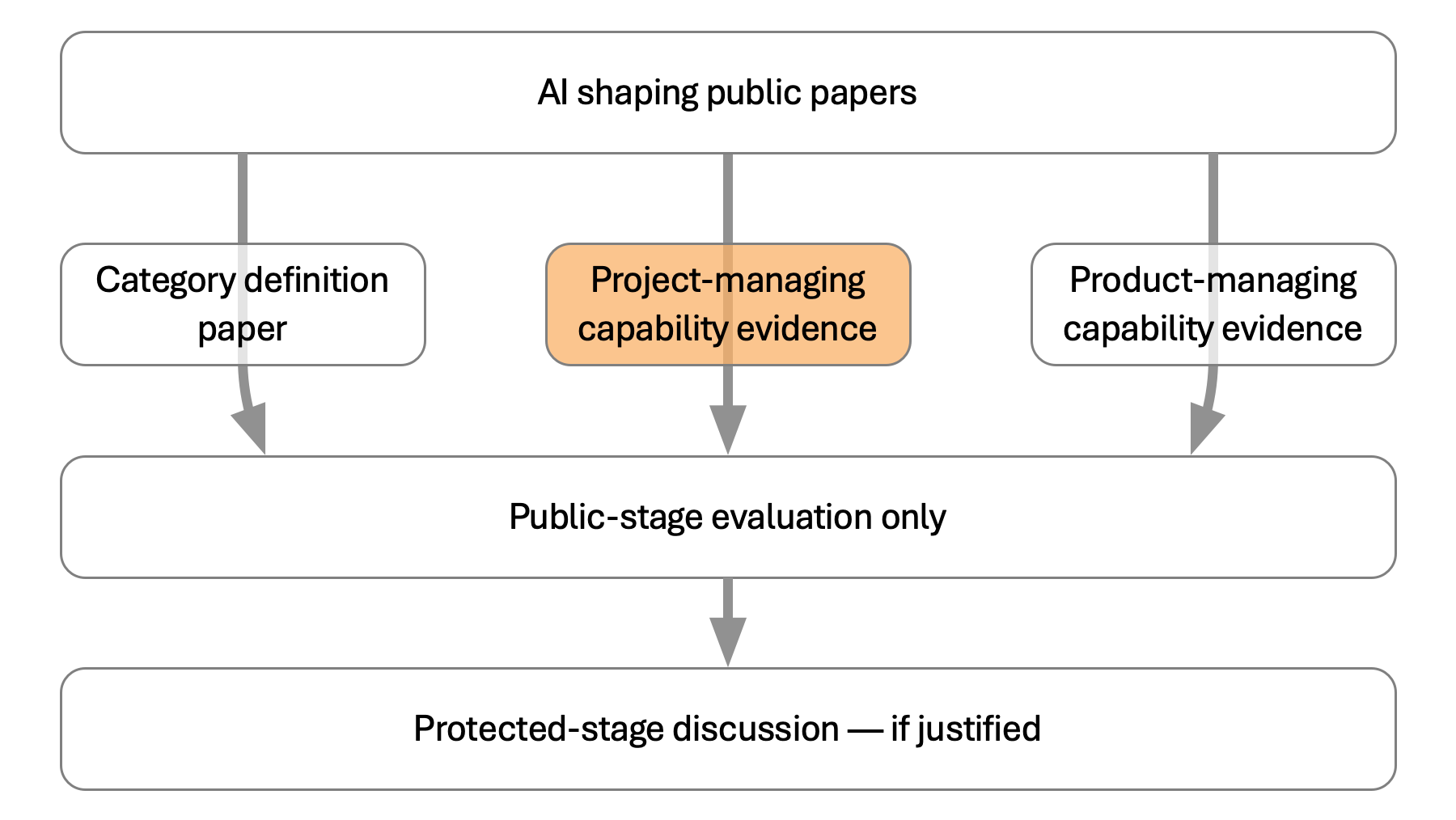
This paper evaluates Project-managing shaped intelligence established through the mediated-shaping approach. The separately published Product-managing paper evaluates bounded operational maturity, observable but unquantified coordination value and direct-approach contribution within a distinct product-level instance; neither paper ranks one shaping approach above the other.
Page 25 of 31